Mentuhotep II, also known as Nebhepetre Mentuhotep II, was one of the greatest kings of ancient Egypt and the ruler who finally reunited the country after generations of political division. He was the most important king of the Eleventh Dynasty and is generally regarded as the ruler who brought the First Intermediate Period to an end and established the Middle Kingdom.
The Egyptian Ministry of Tourism and Antiquities identifies Nebhepetre Mentuhotep as the king who reunited Egypt and initiated the Middle Kingdom, dating his reign to approximately 2055–2004 BC.
Mentuhotep II inherited a country that had been divided between rival kingdoms. The north was dominated by rulers based at Herakleopolis, while the Theban royal family controlled Upper Egypt. His predecessors, including Intef I, Intef II, and Intef III, had spent generations strengthening Thebes and expanding its influence.
Mentuhotep II would complete their work.
His story is one of war, ambition, political strategy, religious symbolism, and national reunification. He transformed Thebes from a regional power into the center of a newly unified Egyptian kingdom and created the foundations for one of the most important periods in Egyptian history.
Egypt Before Mentuhotep II
Several centuries before Mentuhotep II, Egypt had been ruled by powerful kings of the Old Kingdom.
The pharaohs of the Old Kingdom controlled enormous resources and maintained a centralized government. The great pyramids of Giza were built during this period and demonstrated the extraordinary organizational abilities of the Egyptian state.
But eventually, this centralized system weakened.
Provincial governors became increasingly powerful. Local families accumulated land and wealth. Temples became important economic institutions. The central government struggled to maintain authority over distant regions.
After the long reign of Pepi II, Egypt entered a period of political instability.
This era became known as the First Intermediate Period.
Instead of being controlled by one powerful king, Egypt became divided between competing regional rulers.
The traditional idea of a united Egyptian kingdom survived, but political reality was very different.
The Rise of Thebes
During this period of fragmentation, Thebes became increasingly powerful.
The city was located in Upper Egypt along the Nile and had important agricultural and strategic advantages.
The Theban royal family gradually established its own dynasty.
Mentuhotep I helped strengthen the early Theban kingdom.
Intef I continued the process.
Intef II greatly expanded Theban territory and captured Abydos.
Intef III maintained the kingdom's strength.
When Mentuhotep II became king, he inherited a state that was already much stronger than the Thebes of earlier generations.
The stage was now set for the final struggle.
The Rival Kingdom of Herakleopolis
The main rival of Thebes was Herakleopolis Magna.
The rulers of Herakleopolis controlled large areas of northern and central Egypt.
They represented a competing royal tradition and refused to accept Theban supremacy.
For many years, the two kingdoms existed in an uneasy balance.
Sometimes there was open warfare.
At other times, the frontier was relatively quiet.
But both sides understood that Egypt could not remain permanently divided if one dynasty wanted complete control.
Mentuhotep II inherited this rivalry.
The Beginning of His Reign
At the beginning of his reign, Mentuhotep II was primarily the king of Upper Egypt.
His authority was strongest in the south.
He inherited the military and political traditions of the earlier Theban kings.
However, he faced a difficult challenge.
The northern kingdom remained powerful.
The reunification of Egypt would require more than simply ruling Thebes.
Mentuhotep needed to defeat his rivals and establish direct control over the entire Nile Valley.
The Fourteenth Year
One of the most important moments of Mentuhotep II's reign came around his fourteenth regnal year.
An event known as the "Year of the Crime of Thinis" is recorded in Egyptian historical evidence.
The conflict appears to have involved the northern rulers and the sacred region around Abydos and Thinis.
The events triggered a major escalation in the struggle between Thebes and Herakleopolis.
Mentuhotep II responded with military action.
The Theban army moved north.
The final phase of the reunification process had begun.
The Theban Army
Mentuhotep II's military strength was essential to his success.
His army included soldiers from Upper Egypt and other territories under Theban control.
The warriors were equipped with weapons such as bows, spears, shields, and axes.
The Nile provided a natural route for transporting soldiers and supplies.
The army could move northward along the river and attack strategic positions.
The conflict was not simply a single battle.
It was a larger campaign to restore Theban control over the country.
The Battle for Northern Egypt
Mentuhotep II gradually expanded his control northward.
The exact sequence of battles remains uncertain because surviving records do not provide a complete narrative.
However, archaeological and historical evidence indicates that the Theban king eventually defeated the Herakleopolitan rulers.
The political structure that had divided Egypt for generations began to collapse.
Thebes emerged victorious.
Mentuhotep II became the ruler of a unified Egypt.
The Reunification of Egypt
The exact date when reunification was completed is still debated.
However, by the later part of Mentuhotep II's reign, Egypt was once again governed by a single king.
Modern scholarship places the reunification around the beginning of the Middle Kingdom, with Mentuhotep II traditionally dated to approximately the early 21st century BC.
This was a monumental achievement.
Egypt had been divided for generations.
Mentuhotep II restored centralized royal authority.
He effectively ended the political division of the First Intermediate Period.
He became the ruler who reunited the Two Lands.
The "Second Menes"
Because of his achievement, Mentuhotep II was later remembered as a great unifier.
Some historians and Egyptologists have described him as a kind of "second Menes", comparing him with the legendary early king traditionally credited with uniting Upper and Lower Egypt.
The comparison was appropriate.
Both rulers were associated with the creation or restoration of a unified Egyptian state.
Mentuhotep II therefore became an important symbol of national unity.
His New Royal Identity
After reunification, Mentuhotep II changed aspects of his royal titulary.
His royal names emphasized his role as the ruler who had brought the Two Lands together.
His Horus name became associated with the idea of "Uniter of the Two Lands."
This was more than a title.
It was political propaganda.
Every royal monument could remind Egyptians that their king had restored unity.
The message was simple: the period of division was over.
Rebuilding the Egyptian State
Winning the war was only the beginning.
Mentuhotep II had to govern a country that had been politically divided for generations.
He needed to restore centralized administration.
He needed to establish loyalty among local officials.
He needed to rebuild economic institutions.
He needed to secure agricultural production.
He also needed to restore confidence in the monarchy.
This was a major political challenge.
Managing the Nomarchs
During the First Intermediate Period, local governors, or nomarchs, had gained considerable independence.
Some had developed their own political power and controlled large areas.
Mentuhotep II needed to prevent Egypt from returning to the same condition.
He strengthened the central government and rewarded officials who supported the new regime.
The king's authority became stronger throughout the country.
This helped create the stable political structure of the Middle Kingdom.
The Return of Centralized Government
Centralized government was one of Mentuhotep II's greatest achievements.
Royal officials once again became responsible for collecting resources, managing agriculture, organizing construction, and maintaining the king's authority.
The government could coordinate activities across Upper and Lower Egypt.
The country once again functioned as a single political unit.
The reunification therefore changed much more than the identity of the king.
It changed the entire structure of Egyptian government.
Religion and the Divine King
Religion was central to Mentuhotep II's rule.
Egyptians believed that the pharaoh had a special relationship with the gods.
The king was responsible for maintaining maat, the divine principle of order, justice, and harmony.
The division of Egypt had represented political disorder.
Reunification could therefore be presented as the restoration of divine order.
Mentuhotep II used religion to strengthen his political legitimacy.
Montu and Mentuhotep
The name Mentuhotep means approximately "Montu is satisfied."
Montu was an important Theban god associated with warfare, strength, and kingship.
The relationship between Mentuhotep II and Montu was therefore especially appropriate.
The king had defeated his enemies and reunited Egypt.
His military success could be presented as evidence of divine support.
Amun and the Growth of Thebes
Amun was also becoming increasingly important in Thebes.
Although Amun would reach enormous prominence during the New Kingdom, the foundations of his growing importance were already developing during the Middle Kingdom.
The rise of Thebes and the rise of Amun were closely connected.
As Thebes became the political center of unified Egypt, its local god gained greater national importance.
The religious transformation would continue for centuries.
The Temple at Deir el-Bahari
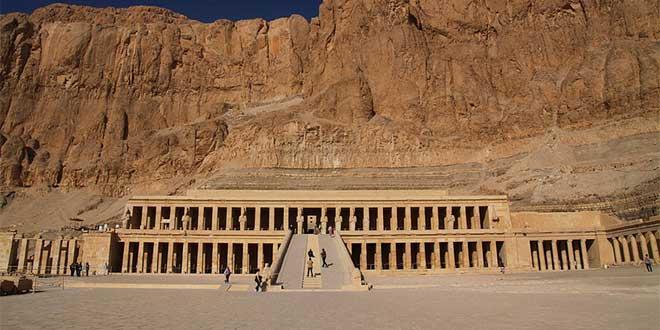
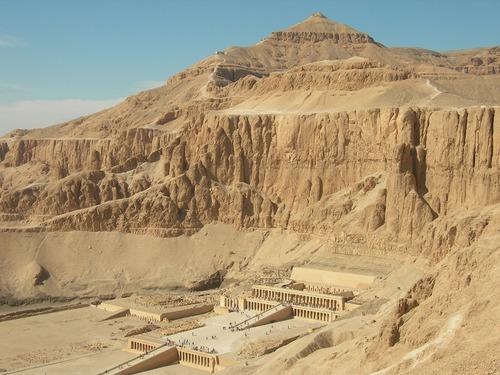
One of Mentuhotep II's greatest monuments was his extraordinary mortuary complex at Deir el-Bahari, on the western bank of the Nile at Thebes.
The Egyptian Ministry of Tourism and Antiquities identifies this location as the burial place of Nebhepetre Mentuhotep and notes that he chose the site centuries before the famous temple of Hatshepsut was built there.
The complex was dramatically positioned beneath the cliffs of western Thebes.
It combined elements of a temple, royal monument, burial complex, and place of eternal commemoration.
A Revolutionary Architectural Design
Mentuhotep II's temple was unlike the pyramid complexes of the Old Kingdom.
It featured terraces, colonnades, ramps, gardens, chapels, and a central monumental structure.
The design took advantage of the natural landscape.
The cliffs behind the temple created a dramatic backdrop.
The monument demonstrated that Egyptian royal architecture was entering a new period.
The Middle Kingdom would develop its own distinctive architectural traditions.
The Mortuary Temple
The temple served several purposes.
It was a place where priests could perform rituals for the deceased king.
It commemorated Mentuhotep's achievements.
It celebrated his relationship with the gods.
It also reinforced his image as the king who restored Egypt.
The Metropolitan Museum of Art describes the complex as both a mortuary monument and a place commemorating Mentuhotep II's military and spiritual leadership in the reunification of Egypt.
The Temple Gardens
The temple complex contained gardens.
Archaeologists discovered evidence of planted trees and carefully arranged vegetation.
The presence of gardens in such an arid environment was a major achievement.
The greenery symbolized life, fertility, regeneration, and eternal renewal.
The garden was also part of the religious symbolism of the temple.
Royal Statues
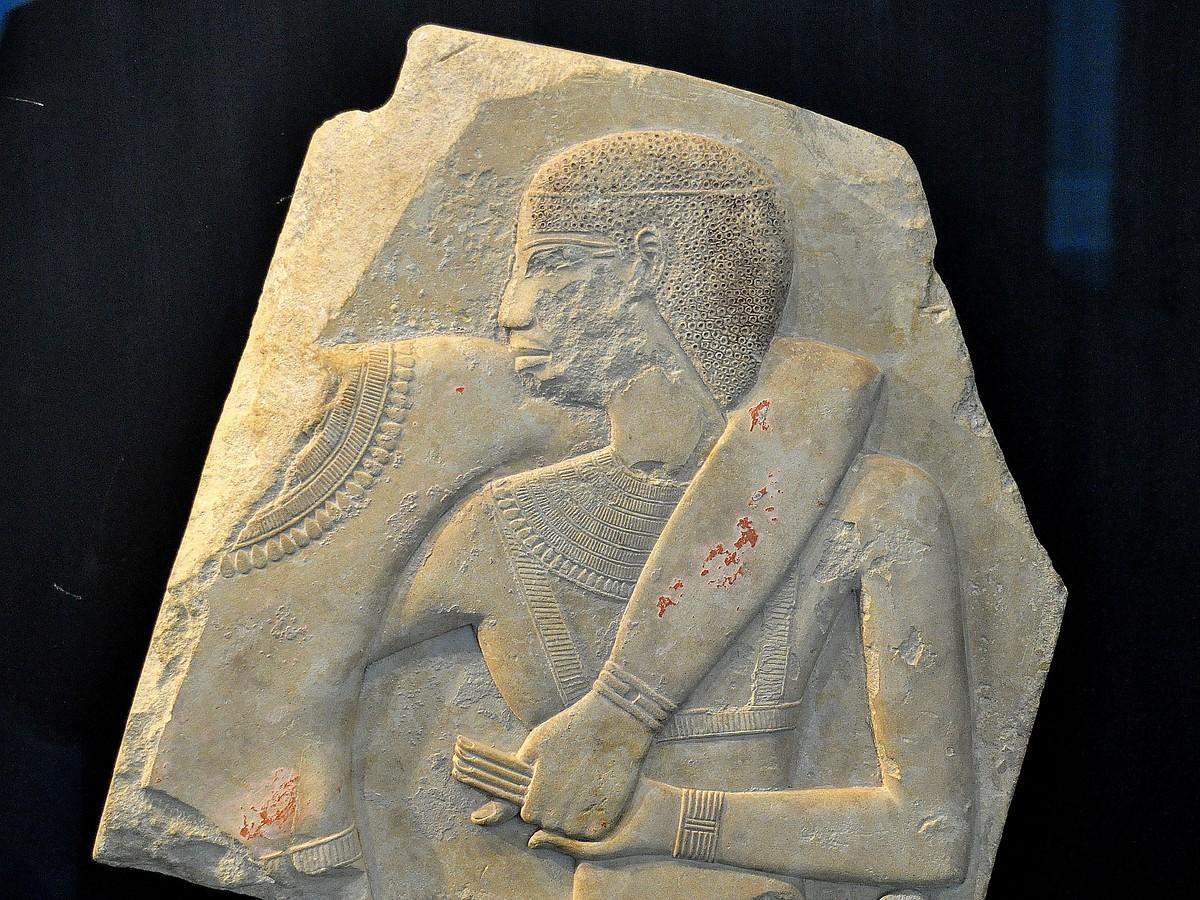
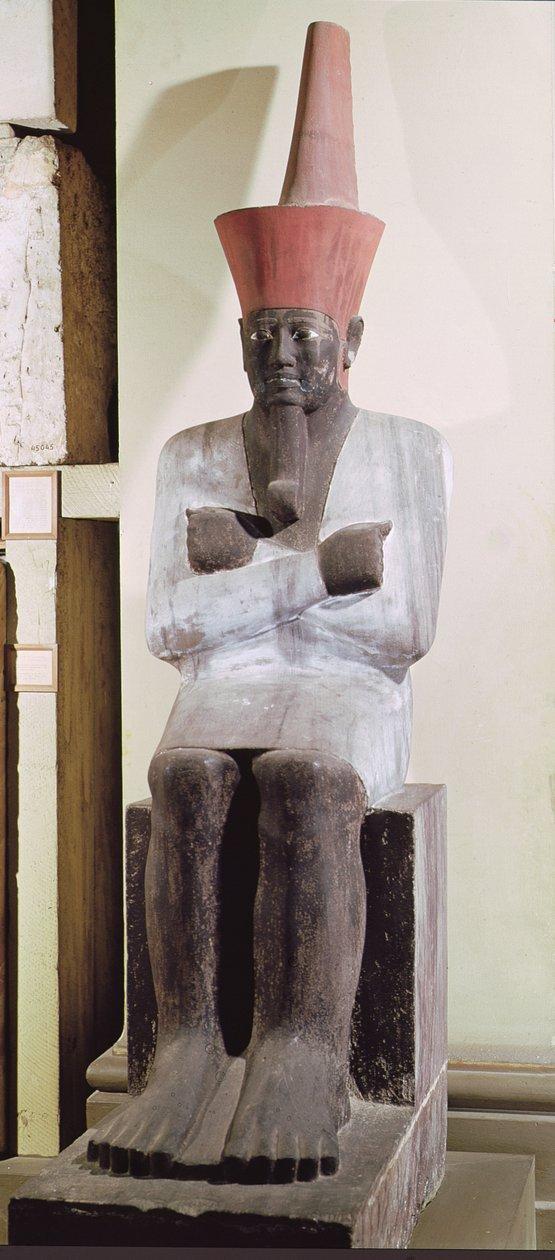
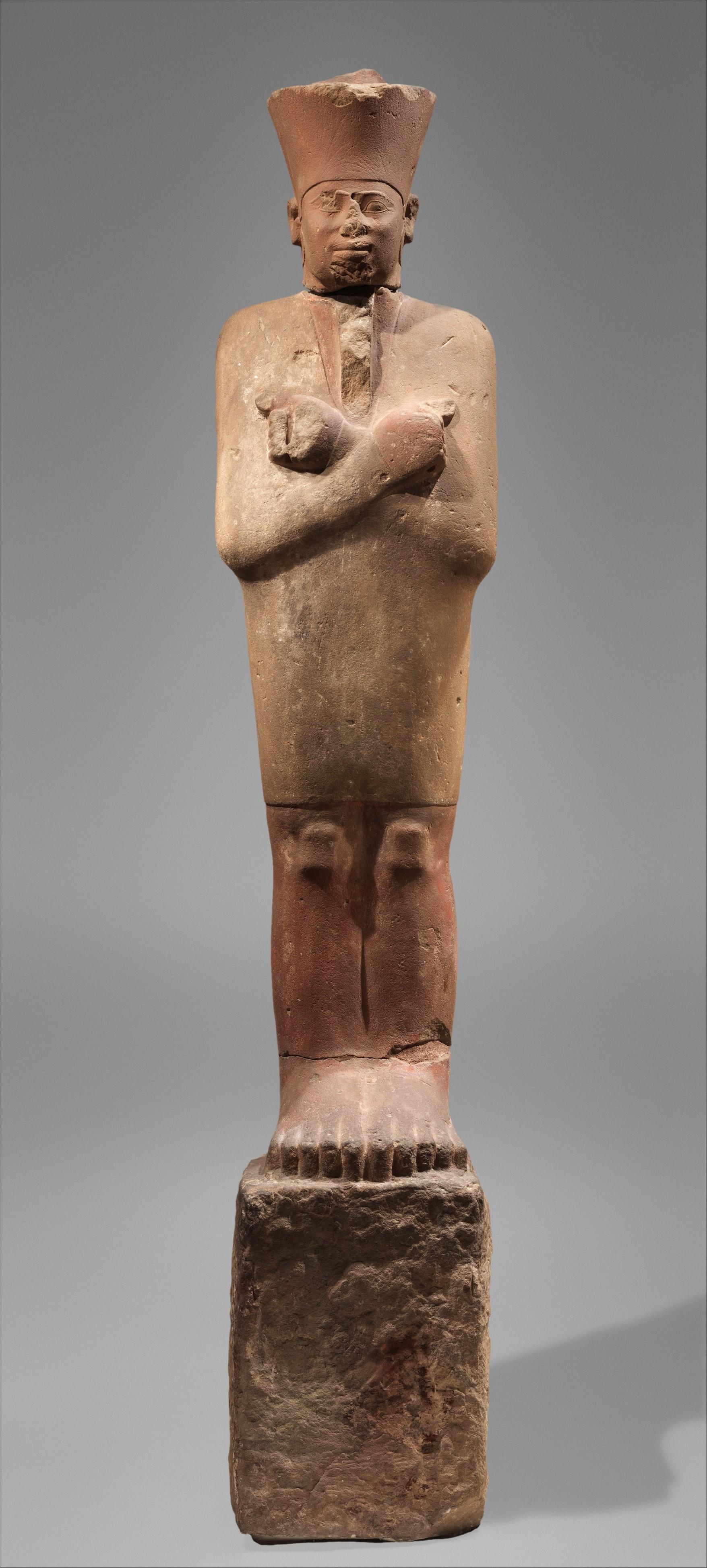
Many representations of Mentuhotep II were created.
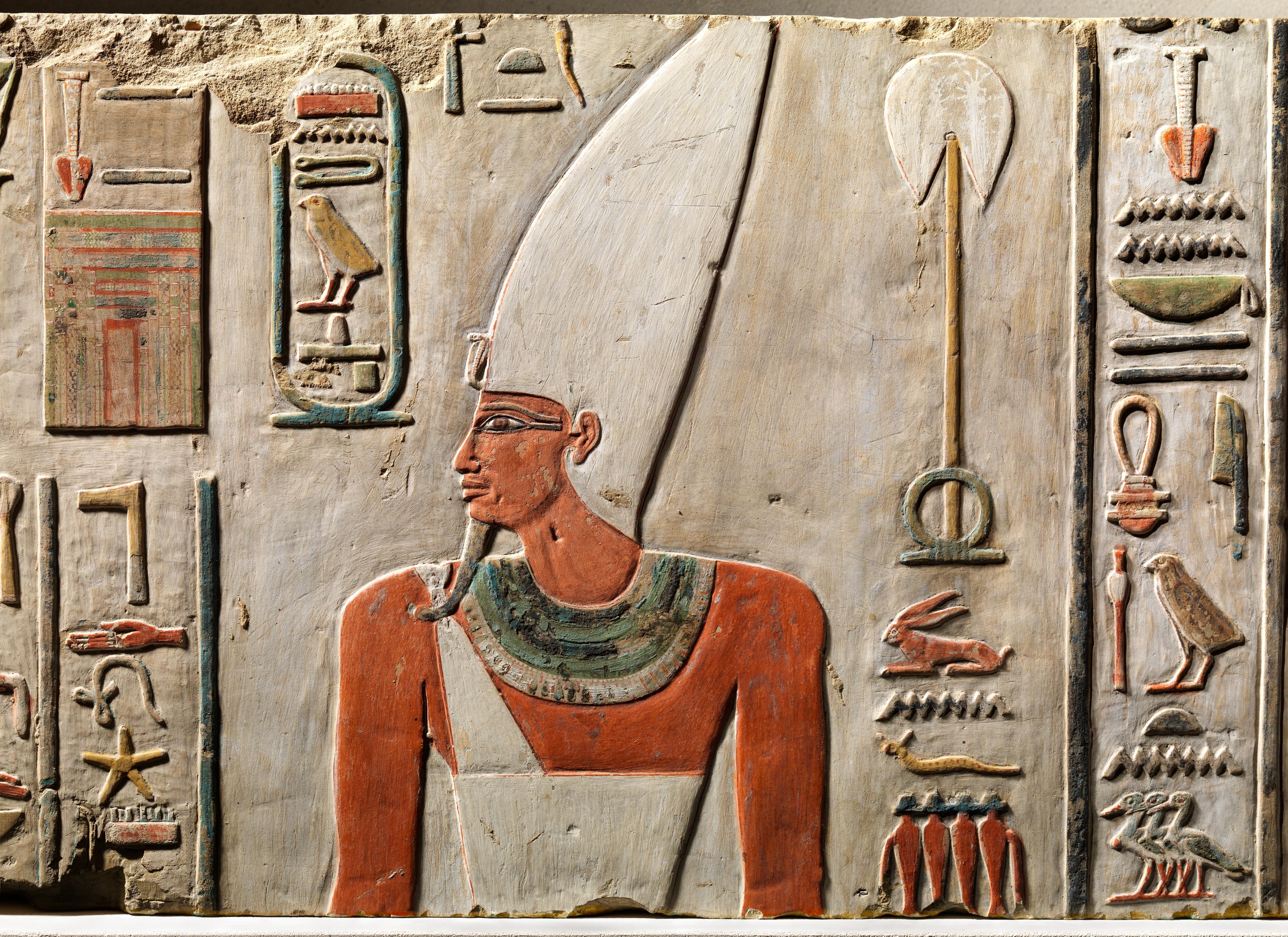
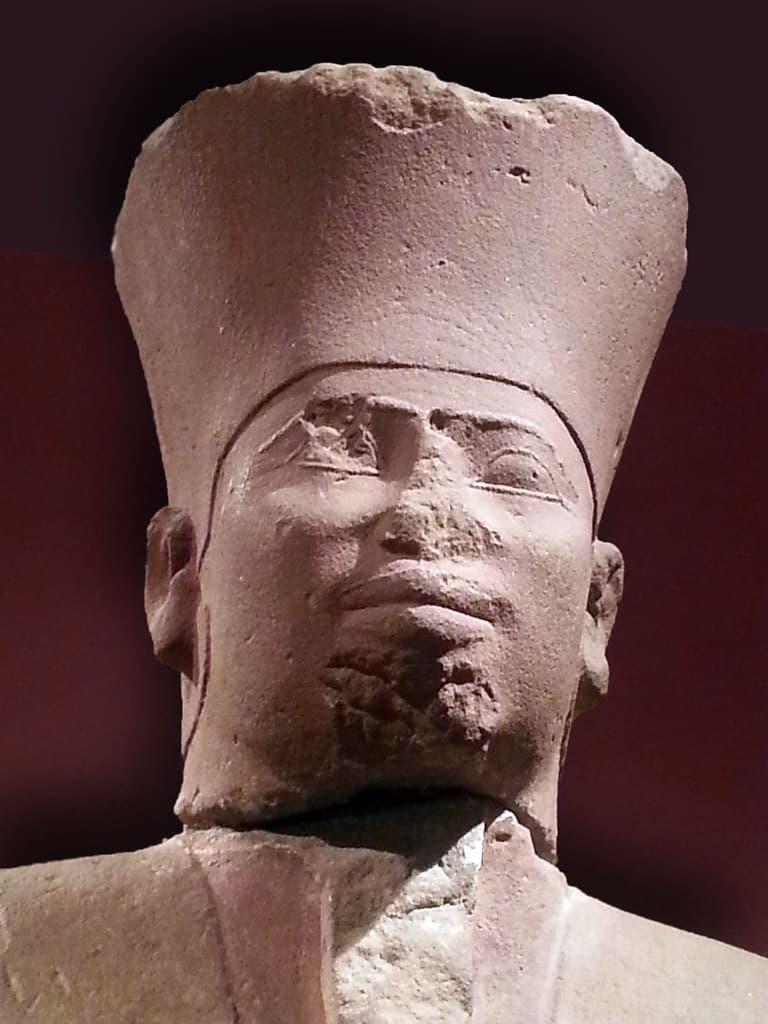
Some statues show him wearing the White Crown of Upper Egypt.
Others show him associated with Lower Egypt.
This visual language reinforced his role as the ruler of both regions.
The statues were not merely portraits.
They were political and religious statements.
They demonstrated that the king had united the Two Lands.
The Sed Festival
Mentuhotep II ruled for a long time.
His long reign allowed him to celebrate royal festivals associated with renewal.
The Sed Festival was traditionally connected with the rejuvenation of the king and his authority.
Evidence from his temple suggests that major royal celebrations were incorporated into the monument during his later reign.
These ceremonies reinforced the idea that the king's power was renewed and divinely supported.
Expansion Beyond Egypt
After reunification, Mentuhotep II could focus more attention on Egypt's borders.
The restored state needed to protect itself from foreign threats.
Egyptian rulers were particularly interested in Nubia to the south.
The region was economically and strategically important.
It provided access to trade routes and valuable resources.
The Middle Kingdom would eventually establish stronger Egyptian control over Nubia.
Trade and Economic Recovery
Reunification improved economic stability.
A unified government could organize agriculture and taxation more efficiently.
Trade routes became easier to control.
Resources could move more freely between regions.
The government could invest in construction projects.
The economy gradually recovered from the instability of the First Intermediate Period.
This helped create the prosperity associated with the Middle Kingdom.
Everyday Life
For ordinary Egyptians, political reunification did not immediately transform every aspect of daily life.
Farmers still depended on the Nile.
Craftsmen continued producing pottery, tools, jewelry, and textiles.
Fishermen worked along the river.
Merchants transported goods.
Priests performed rituals.
Families continued traditional religious practices.
However, greater political stability could provide safer conditions for agriculture, trade, and economic activity.
Literature and Culture
The Middle Kingdom became famous for Egyptian literature.
Stories, teachings, autobiographical texts, and religious works flourished.
The Egyptian language and writing system developed new forms.
Later generations often regarded Middle Kingdom literature as a classical model.
The political stability established by Mentuhotep II helped create the environment in which this cultural development could flourish.
Mentuhotep II as a Divine King
Mentuhotep II was remembered long after his death.
His cult continued at Thebes.
Later Egyptians treated him as a divine or semi-divine royal figure.
The UCL Digital Egypt project notes that the king was worshipped as a god at Thebes in later times.
This demonstrates the extraordinary importance of his reign.
He was not simply remembered as another pharaoh.
He became associated with the restoration of Egypt itself.
His Legacy
Mentuhotep II left behind a unified country.
His successors inherited a much stronger Egypt.
The Eleventh Dynasty continued for several generations.
Later, the Twelfth Dynasty established an even more centralized and prosperous kingdom.
The achievements of Mentuhotep II therefore had consequences far beyond his own lifetime.
The Beginning of the Middle Kingdom
Mentuhotep II's reunification of Egypt marks the beginning of the Middle Kingdom.
The Ministry of Tourism and Antiquities describes the Middle Kingdom as a period extending approximately from 2055 to 1650 BC and identifies Mentuhotep as the king whose reunification initiated it.
This period became one of the great eras of Egyptian civilization.
Central authority was restored.
The economy grew.
Military power expanded.
Trade increased.
Architecture flourished.
Literature reached new heights.
The country entered a new age of stability.
Why Mentuhotep II Was So Important
Mentuhotep II was important because he solved a political problem that had troubled Egypt for generations.
He reunited Upper and Lower Egypt.
He restored the authority of the pharaoh.
He rebuilt centralized government.
He strengthened the economy.
He expanded Egyptian influence.
He created a powerful new royal ideology.
He transformed Thebes into a major national capital.
And he established the foundations of the Middle Kingdom.
Few Egyptian kings had such a profound impact on the political structure of the country.
Conclusion
Mentuhotep II was one of the greatest kings in ancient Egyptian history.
His reign marked the end of one of Egypt's most difficult periods and the beginning of a new era.
He inherited a divided country.
The north was controlled by rival rulers.
The south was controlled by the Theban dynasty.
For generations, earlier kings had fought to strengthen Thebes.
Mentuhotep II inherited their achievements and took the final step.
He defeated the northern opposition and reunited Egypt.
This victory transformed him from a regional king into the ruler of a unified Egyptian state.
His achievement was more than a military victory.
It was a political revolution.
Mentuhotep II restored centralized government and strengthened royal authority.
He reorganized the state and created a political structure capable of governing the entire country.
He also used religion to legitimize his rule.
The king presented himself as the restorer of maat.
His victory represented the return of order after generations of division.
His connection with Montu emphasized his role as a powerful warrior king.
His relationship with the growing cult of Amun connected him with the religious traditions of Thebes.
His greatest monument was his extraordinary mortuary complex at Deir el-Bahari.
The temple combined architecture, religion, royal ideology, and commemoration.
Its terraces and colonnades were built against the dramatic cliffs of western Thebes.
The complex was designed not only as a tomb but also as a permanent monument to the king's achievements.
Centuries later, Hatshepsut would build her famous temple at the same location, making Deir el-Bahari one of the most remarkable landscapes in Egyptian architecture.
Mentuhotep II's influence extended beyond architecture.
He created the political environment in which the Middle Kingdom could flourish.
Agriculture recovered.
Trade expanded.
Egyptian administration became stronger.
Military power was restored.
Culture and literature developed.
The unified Egyptian state once again became one of the strongest powers of the ancient Near East.
Mentuhotep II was also remembered long after his death.
His cult survived at Thebes.
Later Egyptians regarded him as a divine or semi-divine ruler.
His memory was closely connected with the idea of Egyptian unity.
This was his greatest legacy.
He did not simply rule Egypt.
He restored Egypt.
His predecessors had fought to build the power of Thebes.
Mentuhotep II transformed that power into national authority.
He ended the division of Egypt and opened the door to the Middle Kingdom.
For this reason, Mentuhotep II deserves to be remembered alongside the greatest pharaohs of ancient Egypt.
His story is the story of a divided nation becoming united again.
It is the story of a regional dynasty becoming a national monarchy.
It is the story of war followed by reconstruction.
And it is the story of a king whose greatest achievement was not simply winning a throne, but restoring an entire civilization to political unity.
Mentuhotep II was the great unifier of Egypt, the founder of the Middle Kingdom, and one of the most important kings in the long history of ancient Egyptian civilization.