Menkaure was one of the most important rulers of ancient Egypt's Fourth Dynasty and the builder of the smallest of the three great pyramids at Giza. He ruled during the Old Kingdom, a period when Egyptian civilization reached extraordinary levels of political organization, architecture, engineering, and artistic achievement.
Although Menkaure's pyramid is much smaller than the monuments of Khufu and Khafre, his reign remains extremely important. His funerary complex contained some of the finest surviving examples of Old Kingdom sculpture, including the famous Menkaure Triads.
Menkaure was the final pharaoh of the great pyramid-building tradition at Giza. His monuments provide a fascinating glimpse into Egyptian royal power, religion, art, and the beliefs surrounding the afterlife.
Who Was Menkaure?
Menkaure was a king of Egypt's Fourth Dynasty.
He was probably the son of Khafre, the builder of the second pyramid at Giza, and the grandson of Khufu, the builder of the Great Pyramid.
His ancient Egyptian name was Menkaure, which is generally understood to mean something like “Eternal are the Souls of Re” or “Established are the Ka of Re.”
The name reflects the increasing importance of the sun god Ra during the Fourth Dynasty.
The Greek historian Herodotus later recorded his name as Mykerinos.
Egypt During Menkaure's Reign
Menkaure inherited a powerful kingdom.
His predecessors had created enormous pyramids and funerary complexes.
Khufu built the Great Pyramid.
Khafre built the second pyramid and the monumental complex traditionally associated with the Great Sphinx.
Menkaure continued the tradition but chose to build a smaller pyramid.
The reason for the smaller size is not known with certainty.
It may have reflected changes in royal priorities, available resources, religious traditions, or the king's relatively short reign.
The Pyramid of Menkaure
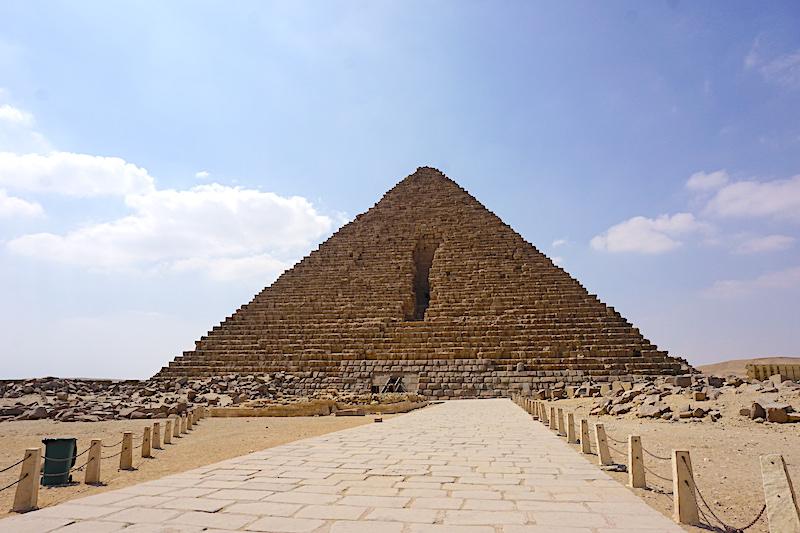
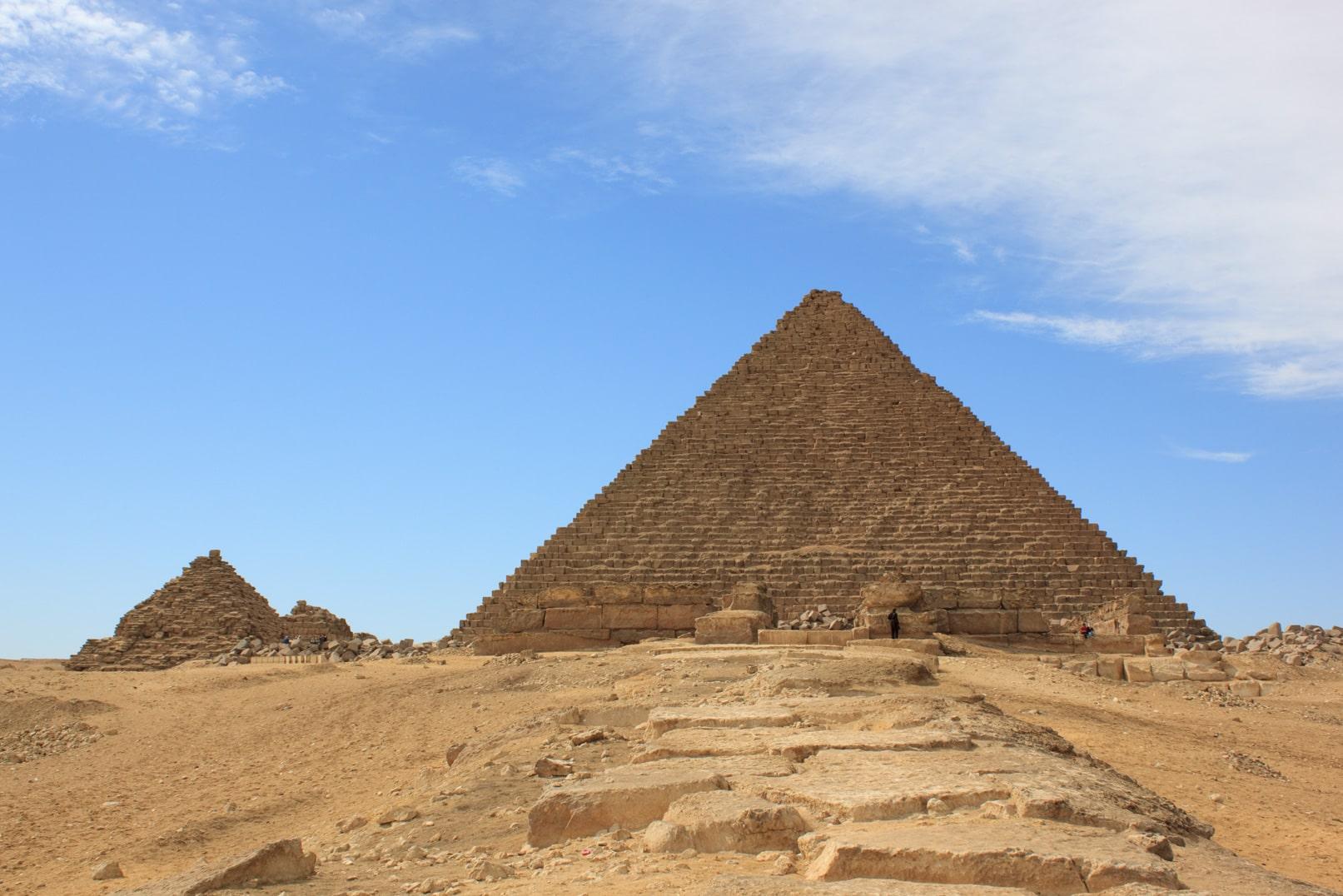
Menkaure's pyramid is located on the Giza Plateau.
The pyramid originally stood approximately 65 meters high.
This is considerably smaller than Khufu's Great Pyramid and Khafre's pyramid.
However, the monument was still an enormous royal tomb.
Its lower sections were partly faced with granite, an extremely hard stone transported from southern Egypt.
Some of the granite casing remains visible today.
The use of granite gave the pyramid a distinctive appearance.
Granite at Menkaure's Pyramid
The builders used granite for important parts of the pyramid complex.
Granite was quarried around Aswan, more than 800 kilometers south of Giza.
Transporting enormous granite blocks to Giza was a major logistical achievement.
The stone could be moved by boat along the Nile during the appropriate seasons.
Once it reached the Giza region, workers transported it to the construction site.
The use of granite demonstrates the organizational power of the Egyptian state.
The Unfinished Granite Blocks
Some areas of Menkaure's pyramid still contain unfinished granite blocks.
These unfinished surfaces provide valuable information about ancient Egyptian construction techniques.
Archaeologists can study the marks left by stoneworkers.
The evidence reveals how the builders shaped and positioned massive blocks.
The unfinished areas also show that the pyramid complex may not have been completely finished when Menkaure died.
Menkaure's Pyramid Complex
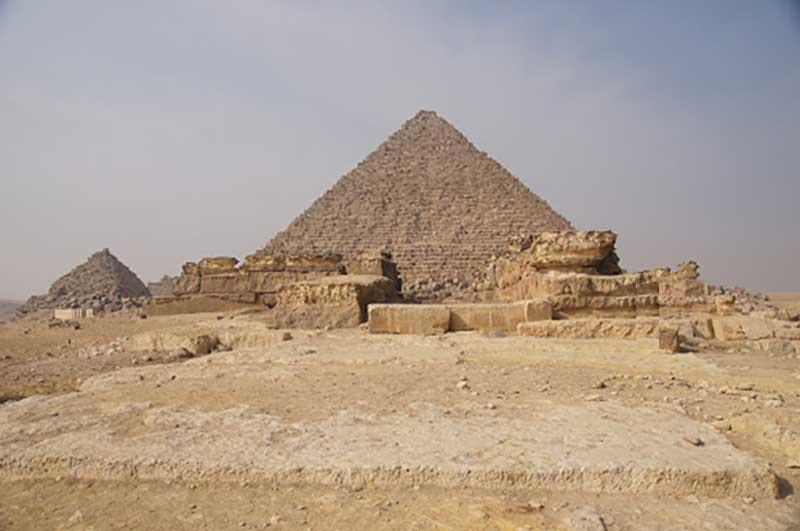
The pyramid was only one part of Menkaure's funerary complex.
The complex included:
- The main pyramid
- A mortuary temple
- A valley temple
- A causeway
- Smaller subsidiary pyramids
- Burial and ceremonial areas
These structures were designed to support the king's eternal existence.
Priests would perform rituals and offerings at the complex after Menkaure's death.
Menkaure's Valley Temple
The valley temple was an important part of the funerary complex.
It served as an entrance and ceremonial area.
Archaeological excavations revealed numerous fragments of statues and architectural elements.
The temple was partly constructed from mudbrick and stone.
Its remains demonstrate that the complex continued to function as a religious center long after Menkaure's death.
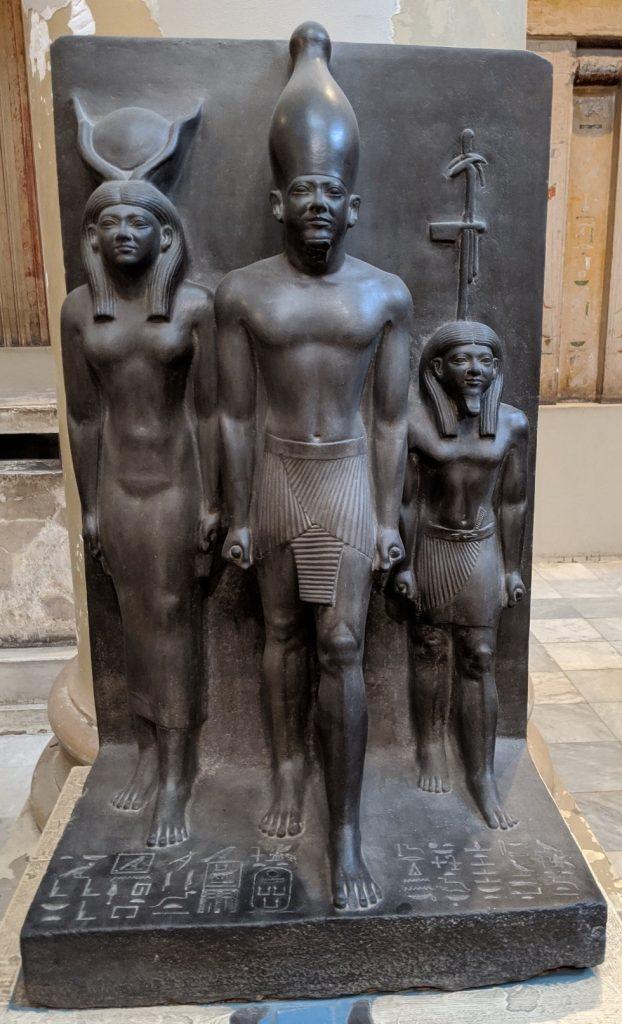
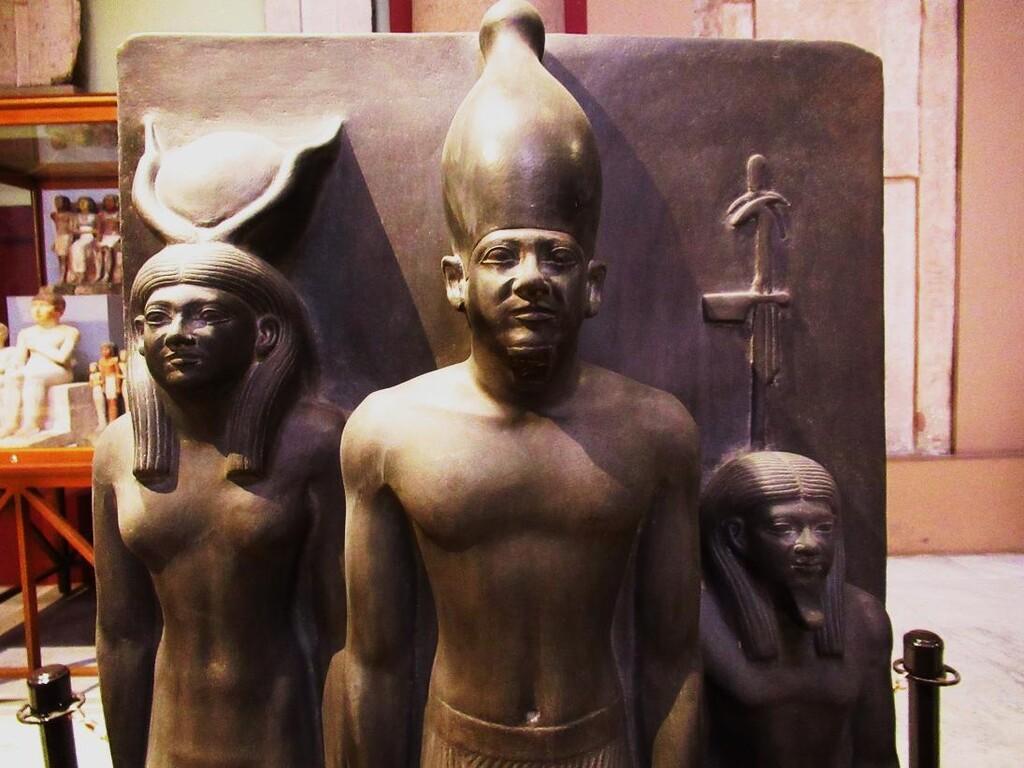
The Menkaure Triads
Among the most famous discoveries associated with Menkaure are the Menkaure Triads.
These statues show Menkaure standing beside the goddess Hathor and a personification of an Egyptian nome, or administrative district.
The figures are carved with extraordinary precision.
Menkaure is shown wearing the traditional royal crown and ceremonial clothing.
Hathor stands beside him as a divine protector.
The third figure represents one of Egypt's regions.
These statues were not simply decorative.
They had religious and political meanings.
The Meaning of the Triads
The triads communicated several important ideas.
Menkaure appears as the legitimate ruler of Egypt.
Hathor represents divine power.
The nome represents the land and people of Egypt.
Together, the figures symbolically connect the king, the gods, and the kingdom.
The statues therefore reinforce the idea that the pharaoh maintained order throughout Egypt.
Menkaure and Hathor
Hathor was one of the most important goddesses in ancient Egypt.
She was associated with motherhood, music, beauty, love, joy, and the protection of the dead.
She also had strong connections with royal ideology.
Her presence in Menkaure's statues emphasized the king's divine legitimacy.
The goddess could also be associated with the western horizon and the afterlife.
This made her particularly appropriate for a royal funerary complex.
Menkaure's Royal Image
Menkaure's sculptures demonstrate the idealized style of Old Kingdom royal art.
The king is young, strong, and calm.
His posture is controlled and symmetrical.
His body does not show ordinary signs of age.
This was intentional.
Egyptian royal sculpture was designed to represent eternal perfection.
The king was not shown as a temporary human being.
He was presented as an everlasting ruler.
Menkaure and the Afterlife
Ancient Egyptians believed that death was a transition to another form of existence.
The king's soul had several important aspects.
The ka was associated with life force and required offerings.
The ba was a spiritual aspect capable of movement.
The king's eternal existence also involved his relationship with the gods.
The pyramid complex provided a place for rituals that maintained the deceased king.
Food, drink, incense, and prayers were offered.
These rituals were intended to continue for generations.
Menkaure and the Sun God Ra
Menkaure's name contains a reference to Ra, the sun god.
Solar religion was especially important during the Fourth Dynasty.
The pharaoh was connected with the sun's eternal cycle.
Every morning, the sun rose.
Every evening, it disappeared into the western horizon.
The Egyptians interpreted this cycle as a symbol of death, renewal, and eternal life.
The pyramid's shape may also have reflected solar symbolism.
Its sides rise toward the heavens.
The Orientation of the Pyramid
Like the other pyramids at Giza, Menkaure's pyramid was carefully oriented.
The builders had sophisticated knowledge of astronomy and geography.
The pyramid's sides correspond closely with the cardinal directions.
This demonstrates the precision of Egyptian surveying.
The orientation was probably connected with religious beliefs as well as practical construction.
Menkaure's Family
Menkaure belonged to one of the most powerful royal families in Egyptian history.
His father was probably Khafre.
His grandfather was Khufu.
The Fourth Dynasty royal family controlled Egypt during the period of the great pyramids.
Menkaure's own family included several children and royal women.
After his death, his successor was Shepseskaf, who was probably a close member of the royal family.
Shepseskaf
Shepseskaf was the final ruler of the Fourth Dynasty.
Unlike Menkaure, he did not build a traditional pyramid.
Instead, he constructed a large mastaba-shaped monument at Saqqara, known today as Mastabat Fara'un.
The change in royal funerary architecture may reflect changes in religious or political priorities.
It also marked the end of the great Fourth Dynasty pyramid tradition.
Menkaure's Pyramid and Later History
Like many Egyptian monuments, Menkaure's pyramid experienced damage over the centuries.
Stone was removed from the exterior.
Natural weathering affected the structure.
Later rulers and local communities sometimes reused ancient materials.
In the medieval period, attempts were even made to destroy or damage the pyramids.
Fortunately, Menkaure's pyramid survived.
The Pyramid's Unusual Damage
The northern face of Menkaure's pyramid shows evidence of later attempts to damage the monument.
Medieval ruler Al-Aziz Uthman, son of Saladin, ordered an attempt to dismantle the pyramids during the 12th century.
The project proved extremely difficult and was eventually abandoned.
The vertical scar visible on Menkaure's pyramid is often associated with these attempts.
The Archaeological Discovery of Menkaure
Modern archaeological exploration at Giza began in earnest during the 19th century.
Researchers excavated Menkaure's pyramid complex and discovered statues, temples, and burial remains.
The Menkaure Triads became particularly important.
They are now displayed in museums and are considered masterpieces of ancient Egyptian art.
These discoveries helped historians understand the religious and political symbolism of the Fourth Dynasty.
Menkaure in Ancient Literature
Later Greek writers remembered Menkaure as a different kind of ruler from Khufu and Khafre.
Herodotus described him as a relatively kind and just king.
He also told stories about Menkaure and his relationship with the Egyptian gods.
However, these accounts were written many centuries after Menkaure lived.
They should therefore be treated as later traditions rather than direct historical records.
Menkaure's Character
It is impossible to know exactly what Menkaure was like as a person.
Ancient sources describe him differently.
Archaeological evidence tells us more about his role as king than about his personality.
His monuments show that he continued to support royal architecture and religious institutions.
The statues associated with his reign present him as an ideal and divine ruler.
Egypt's Economy Under Menkaure
The Egyptian economy was based on agriculture.
The Nile provided fertile soil and reliable transportation.
Farmers cultivated grain and other crops.
The state collected and redistributed agricultural resources.
Workers building the pyramid complex received food and supplies.
Craftsmen worked in organized workshops.
The government also controlled access to quarries and trade routes.
This economic structure allowed Menkaure to continue large-scale construction.
Trade and Resources
Menkaure's government relied on resources from throughout Egypt.
Granite came from Aswan.
Limestone was obtained from nearby quarries.
Copper and turquoise were available from Sinai.
Nubia provided access to southern resources and trade routes.
The ability to move these materials across long distances demonstrated the strength of the Old Kingdom state.
Why Menkaure's Pyramid Was Smaller
One of the most common questions about Menkaure is why his pyramid was much smaller than those of Khufu and Khafre.
There is no definitive answer.
Several possibilities exist.
Menkaure may have had a shorter reign.
The project may have been changed during construction.
The king may have chosen to invest more resources in temples and statues.
Religious ideas may also have changed.
The use of expensive granite suggests that size was not the only measure of importance.
Menkaure's Artistic Legacy
Menkaure's greatest artistic legacy is his collection of royal sculptures.
The triads demonstrate extraordinary skill in carving hard stone.
The statues show a balance between realism and idealization.
The king's body is powerful but not exaggerated.
His facial expression is calm.
The figures stand in carefully controlled poses.
This artistic style became a defining feature of Old Kingdom sculpture.
Menkaure and the End of the Fourth Dynasty
Menkaure's reign was followed by Shepseskaf.
With Shepseskaf, the Fourth Dynasty eventually came to an end.
Egypt entered the Fifth Dynasty.
The great pyramid-building tradition gradually changed.
Later kings continued to construct pyramids, but they generally built smaller monuments.
Temples dedicated to the sun god Ra became increasingly important.
This marked a new stage in Old Kingdom religious and political development.
Menkaure's Legacy
Menkaure remains an important figure in Egyptian history because his reign represents the final stage of the great Giza pyramid tradition.
His pyramid may be smaller than those of Khufu and Khafre, but his complex produced some of the finest royal sculptures ever created in ancient Egypt.
The Menkaure Triads provide a unique visual representation of the relationship between the king, the gods, and the Egyptian provinces.
His granite pyramid also demonstrates the extraordinary logistical abilities of the Old Kingdom.
Why Menkaure Matters
Menkaure matters because he represents the combination of architecture, religion, art, and political authority.
His pyramid demonstrates engineering.
His temples demonstrate organization.
His statues demonstrate artistic mastery.
His name demonstrates the importance of solar religion.
His funerary complex demonstrates the Egyptian belief in eternal royal existence.
Together, these elements create a remarkable picture of Old Kingdom civilization.
Conclusion
Menkaure was one of the most important pharaohs of Egypt's Fourth Dynasty and the builder of the smallest of the three great pyramids at Giza.
Although his pyramid is smaller than the monuments of Khufu and Khafre, it remains an extraordinary achievement.
Its use of granite demonstrates the wealth and engineering ability of the Egyptian state.
The surrounding funerary complex contained temples, causeways, subsidiary pyramids, and numerous royal sculptures.
Among the most famous are the Menkaure Triads, which show the king alongside the goddess Hathor and personifications of Egyptian nomes.
These statues reveal the political and religious ideas of the Old Kingdom.
Menkaure's name was connected with the sun god Ra, reflecting the increasing importance of solar religion during the Fourth Dynasty.
His reign also continued the traditions of centralized government, agriculture, trade, quarrying, and large-scale construction.
After his death, Shepseskaf became king and the Fourth Dynasty eventually came to an end.
Yet Menkaure's monuments remained.
His pyramid continues to stand on the Giza Plateau, while his statues survive in museums around the world.
Menkaure's legacy is not measured only by the size of his pyramid. His true importance lies in the extraordinary combination of engineering, sculpture, religion, and royal symbolism that made his reign one of the most fascinating chapters in the history of ancient Egypt.