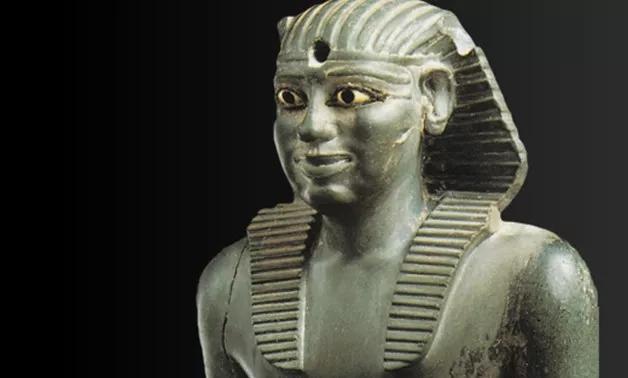
Unas, also known as Wenis, was the last pharaoh of Egypt’s Fifth Dynasty and one of the most historically important rulers of the Old Kingdom. Although his reign was relatively short compared with some of the great kings of ancient Egypt, Unas left behind a monument that changed the way historians understand ancient Egyptian religion.
His pyramid at Saqqara is famous for containing some of the earliest known extensive religious inscriptions inside an Egyptian royal tomb. These inscriptions are known as the Pyramid Texts.
The Pyramid Texts contain spells, prayers, hymns, and religious formulas intended to protect the dead king and help him reach the afterlife. They provide an extraordinary glimpse into the beliefs of ancient Egyptians more than four thousand years ago.
Unas ruled at the end of the Fifth Dynasty, following the long reign of Djedkare Isesi. His reign marked the final stage of a dynasty that had transformed Egyptian royal religion through its strong connection with the sun god Ra.
Unas's Early Life
Very little is known about Unas's childhood.
The identity of his parents has not been established with certainty.
He probably grew up within the royal court and received an education appropriate for a future member of Egypt's ruling elite.
As a royal prince or high-ranking member of the court, he would have been surrounded by priests, scribes, administrators, craftsmen, and military officials.
He would also have learned about the religious responsibilities of the pharaoh.
Ancient Egyptian kingship was not simply political.
The pharaoh was considered the earthly representative of the gods and was responsible for maintaining maat, the divine order of the universe.
Unas Becomes Pharaoh
Unas succeeded Djedkare Isesi and became the final ruler of the Fifth Dynasty.
The transition appears to have been relatively peaceful.
Egypt remained a powerful kingdom with a sophisticated administration.
The royal government controlled agriculture, taxation, temples, construction projects, and trade.
Unas inherited this established system from Djedkare.
However, the political and religious landscape was gradually changing.
The Fifth Dynasty had originally been strongly associated with the worship of the sun god Ra.
By the time of Unas, the royal religious system was becoming more complex, with increasing emphasis on funerary beliefs and the god Osiris.
The Length of Unas's Reign
Unas probably ruled for around three decades, although the exact length of his reign remains uncertain.
Some ancient sources and later interpretations suggest a relatively long reign, while other evidence has led scholars to propose a shorter period.
Regardless of the exact number of years, Unas had enough time to construct his pyramid complex and maintain the administration of the kingdom.
His reign appears to have been relatively stable.
Unas's Pyramid at Saqqara
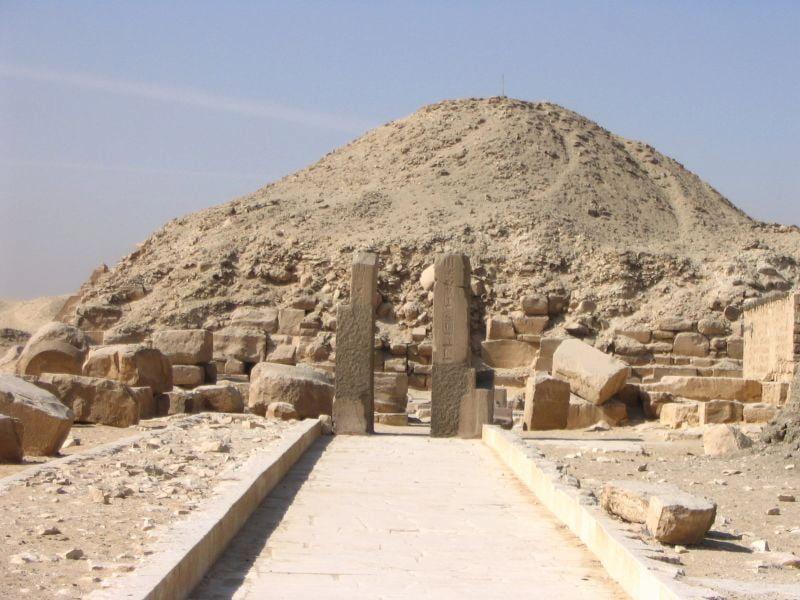
Unas built his pyramid at Saqqara, near the great Step Pyramid of Djoser.
His pyramid was originally called "Beautiful are the places of Unas."
Compared with the enormous pyramids of Giza, the pyramid of Unas was relatively small.
However, its importance is not determined by its size.
The pyramid became famous because of the religious inscriptions carved inside it.
These inscriptions are among the most important surviving texts from ancient Egypt.
The Pyramid Texts
The greatest legacy of Unas is the Pyramid Texts.
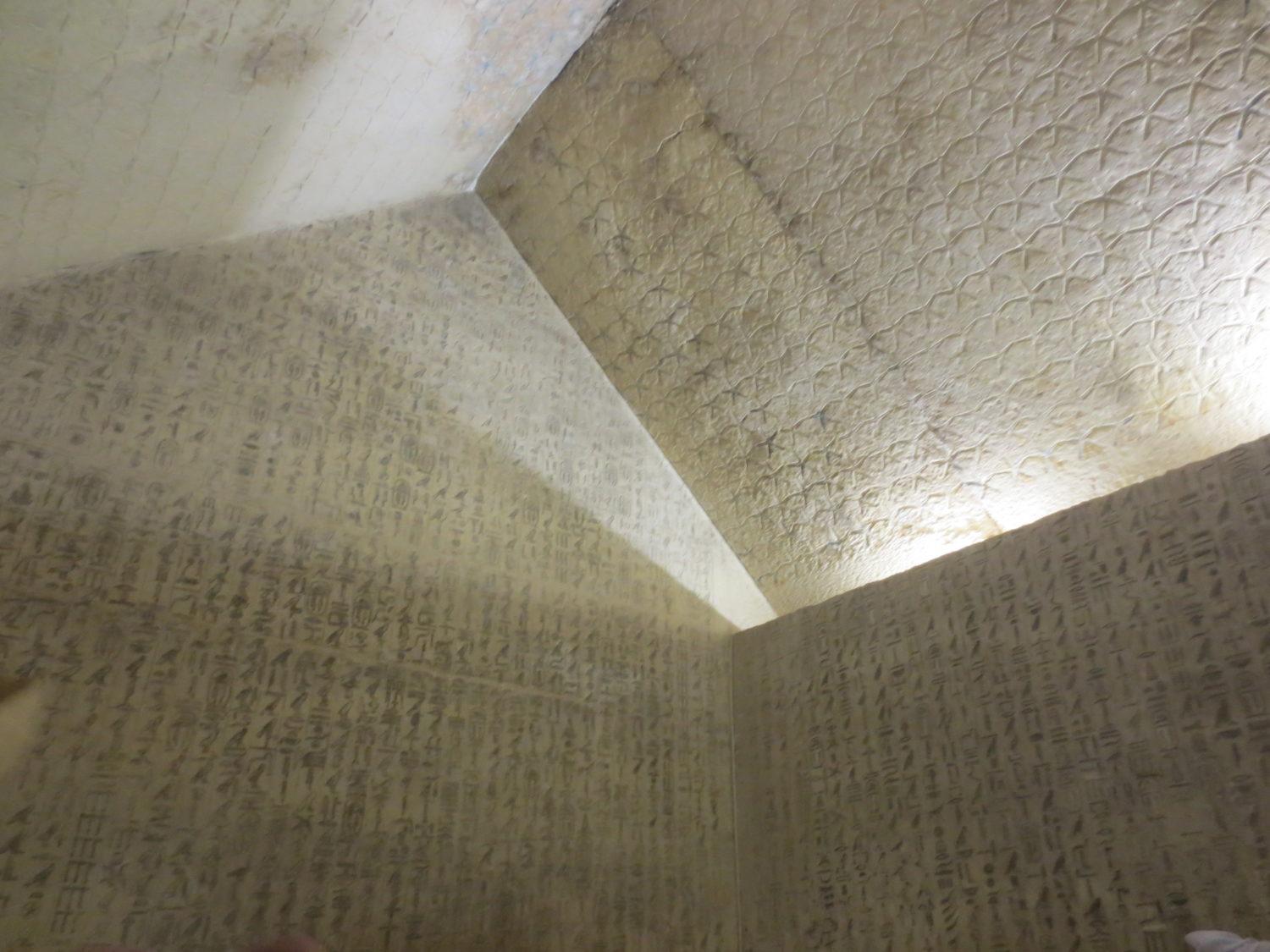
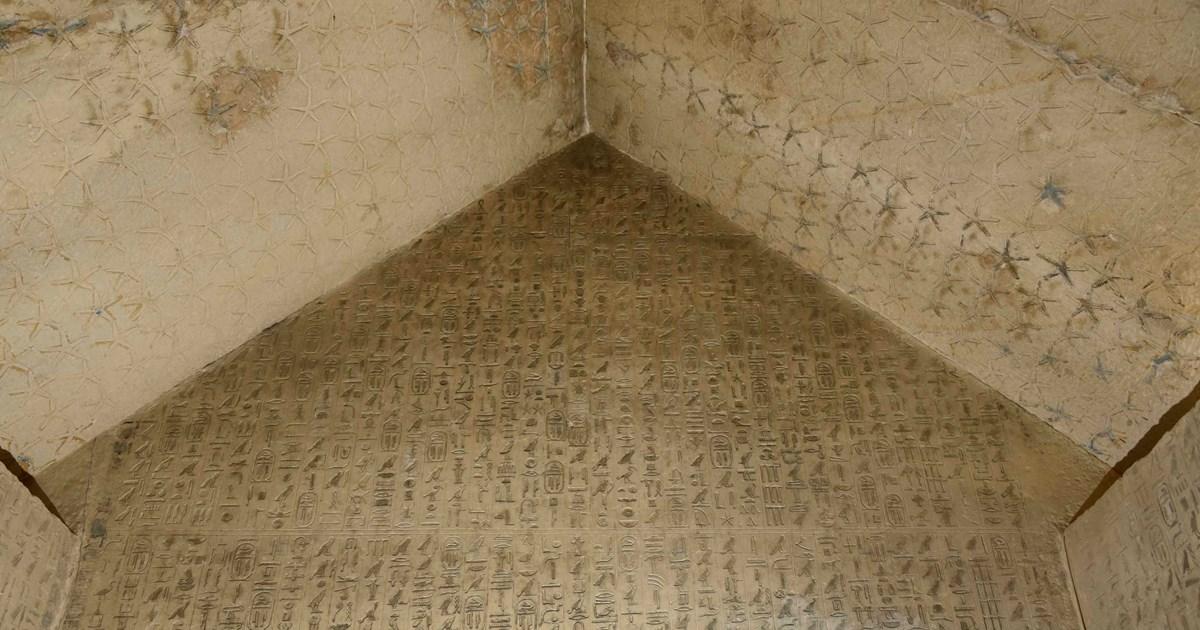
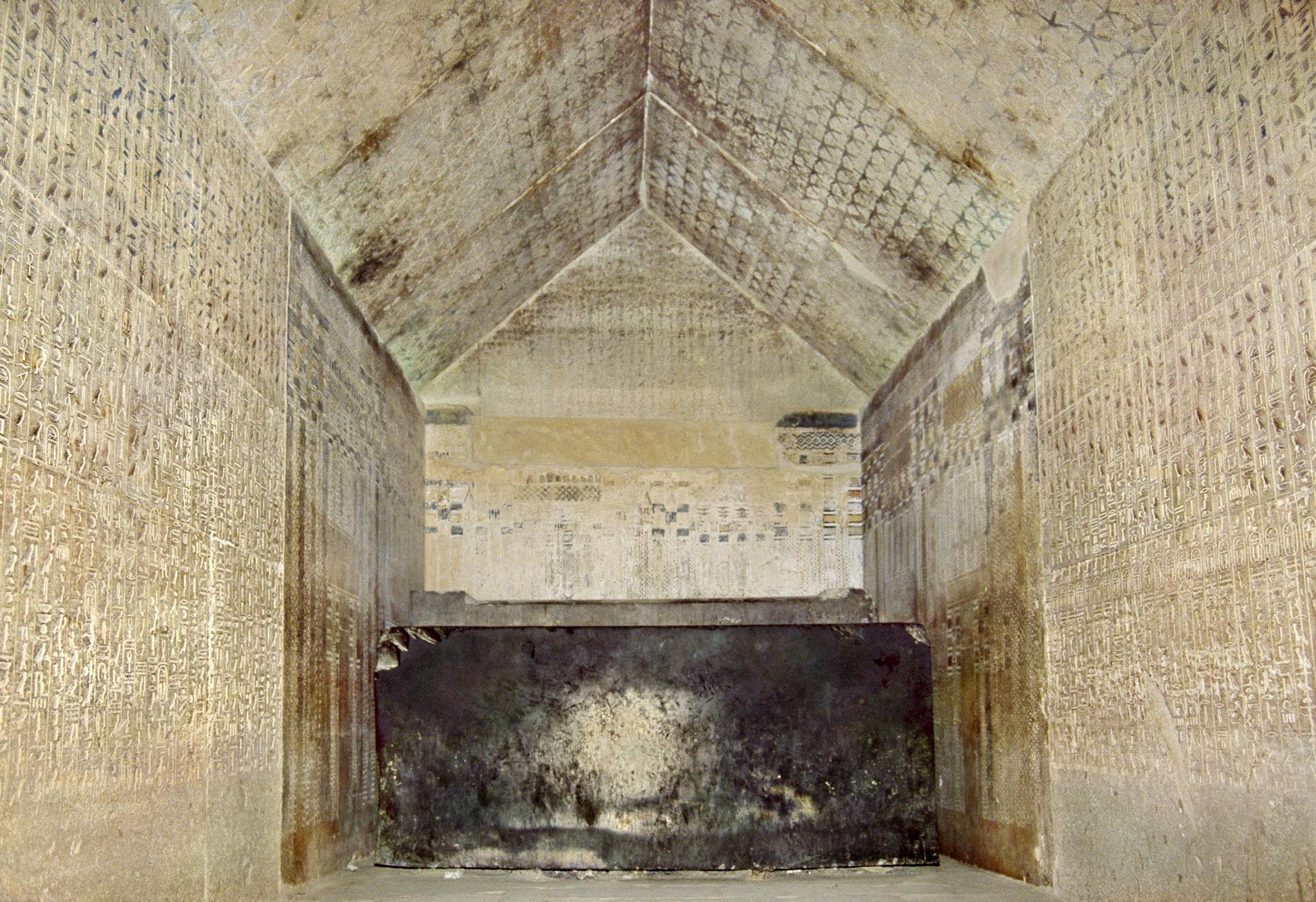
The walls inside his pyramid are covered with hundreds of religious spells and inscriptions.
They were intended to protect the king and help him successfully enter the afterlife.
The texts describe journeys through the heavens, encounters with gods, magical protection, offerings, resurrection, and the king's transformation into a divine being.
They provide some of the earliest extensive evidence of Egyptian religious thought.
Why the Pyramid Texts Are Important
The Pyramid Texts are among the oldest religious writings known from ancient Egypt.
They preserve ideas that were probably much older than the pyramid of Unas itself.
The texts were not necessarily invented during his reign.
Instead, Unas's scribes and priests recorded religious traditions that had developed over generations.
The inscriptions therefore provide evidence of beliefs that may have existed long before they were written on the walls of his pyramid.
The Journey to the Afterlife
Ancient Egyptians believed that death was a transition rather than an end.
The dead king needed to travel through the supernatural world.
He had to overcome dangers, pass through gates, communicate with gods, and reach his eternal destination.
The Pyramid Texts provided magical and religious assistance for this journey.
The spells helped transform Unas from a dead human king into an eternal divine ruler.
Unas and the Sun God Ra
The sun remained extremely important during Unas's reign.
The ancient Egyptians believed that the sun traveled across the sky during the day and through the underworld during the night.
The daily journey represented renewal and resurrection.
The king could join the solar cycle and travel with Ra.
This connection helped guarantee eternal life.
Unas and Osiris
At the same time, Osiris became increasingly important.
Osiris was associated with death, resurrection, and the afterlife.
According to Egyptian mythology, Osiris had been murdered by his brother Seth and restored to life through the actions of Isis.
The deceased king was connected with Osiris.
This allowed the king to achieve resurrection and eternal existence.
The Pyramid Texts contain many references to Osiris and related funerary beliefs.
The King as a Divine Being
Egyptian kingship was based on the idea that the pharaoh had a divine nature.
During life, the king was associated with Horus.
After death, he became connected with Osiris.
At the same time, he could join the gods of the heavens and the solar cycle.
The Pyramid Texts express these ideas through complex religious language.
Unas was therefore not simply buried.
He was transformed into an eternal supernatural king.
The Architecture of Unas's Pyramid Complex
Unas's pyramid complex followed the traditional structure of Old Kingdom royal funerary monuments.
It included the pyramid, a mortuary temple, a causeway, a valley temple, and associated ritual spaces.
The causeway connected the lower part of the complex with the pyramid.
Reliefs and architectural elements once decorated these areas.
Although much of the complex has been damaged, important remains survive.
The Causeway of Unas
The causeway leading to Unas's pyramid was decorated with scenes showing different aspects of Egyptian life.
Some scenes depicted animals, plants, boats, workers, and agricultural activities.
These reliefs were valuable not only for religious reasons but also as historical records.
They provide information about the environment, economy, transportation, and artistic traditions of the Old Kingdom.
Unas's Pyramid Chamber
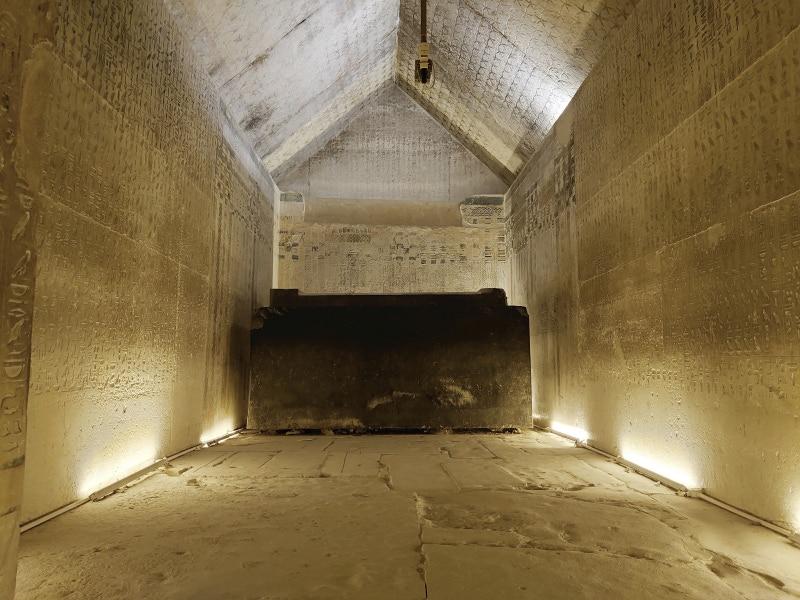
Inside the pyramid, the burial chambers contain the famous Pyramid Texts.
The walls are covered with carefully arranged hieroglyphic inscriptions.
The texts were carved and painted, creating a powerful religious environment around the king's burial place.
The interior demonstrates how Egyptian architecture and religious writing were combined to protect the deceased pharaoh.
The Burial of Unas
Unas was buried inside his pyramid.
His burial would have included a range of funerary equipment, offerings, rituals, and religious ceremonies.
Priests were expected to maintain his mortuary cult after his death.
Offerings of food and drink were presented to his spirit.
The pyramid complex therefore continued to function as a religious institution long after the king's burial.
Unas's Family
The identity of Unas's parents remains uncertain.
However, several royal women are known from his reign.
His queens included Nebet and Khenut, both of whom had important funerary monuments near his pyramid complex.
Their tombs provide additional information about the royal family of the late Fifth Dynasty.
Royal women could possess significant status within the palace and religious system.
Queen Nebet
Nebet was one of Unas's known queens.
Her tomb was discovered near the pyramid complex.
The existence of her funerary monument demonstrates the importance of royal women.
Queens participated in the royal family structure and were closely connected with the religious traditions surrounding the king.
Queen Khenut
Another important queen was Khenut.
Her tomb was also located near Unas's pyramid.
Her burial complex contains evidence of the high status enjoyed by royal women during the late Fifth Dynasty.
Together, the monuments of Nebet and Khenut help historians understand Unas's royal household.
Administration Under Unas
Unas inherited a sophisticated Egyptian bureaucracy.
Officials were responsible for collecting taxes, managing agricultural estates, organizing construction projects, maintaining temples, and controlling trade.
Scribes recorded economic information.
The vizier and other senior officials helped administer the kingdom.
The government remained centralized, although local officials were becoming increasingly influential.
Agriculture During Unas's Reign
Egyptian civilization depended on the Nile.
The annual flood provided fertile soil for agriculture.
Farmers grew wheat, barley, flax, vegetables, and other crops.
The government collected agricultural products as taxes.
These resources supported the royal court, temples, workers, and officials.
Agricultural prosperity was essential to maintaining the Egyptian state.
Trade and Expeditions
Egypt continued to send expeditions to neighboring regions.
The Sinai Peninsula provided copper and turquoise.
Nubia was important for gold and other resources.
The Eastern Desert supplied valuable stone and minerals.
Egyptian expeditions also maintained contact with distant lands through Red Sea trade networks.
These activities demonstrate that Egypt remained economically active during Unas's reign.
Unas and Foreign Lands
Egyptians were familiar with many regions beyond the Nile Valley.
Trade and expeditions brought foreign products into Egypt.
Some of these included incense, precious stones, metals, exotic animals, and luxury goods.
Foreign peoples were sometimes represented in Egyptian art.
These representations provide evidence of Egypt's awareness of neighboring cultures.
Military Activity
The Egyptian state also had to protect its borders.
Military expeditions could be organized to secure trade routes and maintain access to resources.
Evidence from the period suggests that Egyptian forces operated beyond the Nile Valley.
However, Unas's reign is not remembered for a major war or foreign invasion.
His most important legacy remains religious and architectural rather than military.
Unas and Maat
Like every Egyptian king, Unas was expected to preserve maat.
Maat represented order, truth, justice, and balance.
The pharaoh's responsibility was to prevent chaos and ensure that Egypt remained prosperous.
Religious rituals, temple offerings, agricultural management, and political authority were all connected to this concept.
The king's legitimacy depended on his ability to maintain divine order.
The Art of Unas's Reign
The artistic traditions of the late Fifth Dynasty were highly developed.
Reliefs showed animals, plants, people, boats, religious ceremonies, and royal activities.
Artists followed established conventions.
The pharaoh was usually shown as youthful and powerful.
Private individuals could be represented with more naturalistic details.
The quality of the reliefs from this period demonstrates the skill of Old Kingdom craftsmen.
The Importance of Saqqara
Saqqara was one of Egypt's most important burial grounds.
It had already become famous because of the Step Pyramid of Djoser.
By the time of Unas, the area contained numerous royal and private monuments.
Unas's pyramid added another important monument to the site.
Today, the area provides an extraordinary record of Egyptian history over thousands of years.
Unas and the End of the Fifth Dynasty
Unas was the final pharaoh of the Fifth Dynasty.
His death marked the end of a royal line that had ruled Egypt for several generations.
The next dynasty, the Sixth Dynasty, began with Teti.
The transition appears to have been relatively peaceful, although the exact circumstances remain uncertain.
Teti married Iput, who was probably connected to the royal family of Unas.
This marriage may have helped strengthen Teti's claim to the throne.
The Beginning of the Sixth Dynasty
Teti founded the Sixth Dynasty.
The new dynasty continued many traditions of the Old Kingdom.
The royal court remained powerful.
Pyramids continued to be built.
Religious traditions continued to develop.
The Pyramid Text tradition introduced by Unas became increasingly important during the Sixth Dynasty.
Unas's Historical Legacy
Unas's greatest contribution to Egyptian history was his pyramid and its religious inscriptions.
The Pyramid Texts became the foundation for later Egyptian funerary literature.
Later collections of funerary spells, including the Coffin Texts and eventually the Book of the Dead, preserved and expanded many similar religious ideas.
The pyramid of Unas therefore represents an important stage in the development of Egyptian beliefs about death and resurrection.
Unas in Modern Egyptology
Modern archaeologists and historians have studied Unas's pyramid extensively.
The inscriptions inside the pyramid have been carefully documented and translated.
They provide information about Egyptian gods, mythology, rituals, royal ideology, and beliefs about the afterlife.
Because the texts preserve very old religious traditions, they are essential for understanding the development of ancient Egyptian religion.
Why Unas Is Important
Unas may not have built the largest pyramid in Egypt.
He did not conquer a vast empire.
He is not remembered for enormous military victories.
Instead, his importance comes from the remarkable religious legacy he left behind.
His pyramid contains one of the oldest and most important collections of religious writings in human history.
These inscriptions allow modern people to understand the religious world of ancient Egypt.
Conclusion
Unas was the last pharaoh of Egypt's Fifth Dynasty and one of the most important rulers of the Old Kingdom from a religious and historical perspective.
His reign continued the traditions of the Fifth Dynasty while also reflecting the changing religious ideas of ancient Egypt.
His pyramid at Saqqara may appear modest compared with the enormous pyramids of Giza, but its interior contains an extraordinary treasure: the Pyramid Texts.
These sacred inscriptions were created to protect the deceased king, guide him through the afterlife, and help him become an eternal divine ruler.
The texts reveal the importance of gods such as Ra, Osiris, Horus, Anubis, and Isis, while also explaining ancient Egyptian ideas about death, resurrection, heaven, and divine kingship.
Unas's reign also continued Egypt's agricultural system, administration, trade, mining expeditions, and relationships with neighboring regions.
His queens, Nebet and Khenut, left important monuments that provide additional evidence about the royal family.
After Unas's death, Teti became the first king of the Sixth Dynasty, marking the beginning of a new chapter in Old Kingdom history.
Today, Unas is remembered not because of the size of his pyramid, but because of what was written inside it.
The Pyramid of Unas transformed a royal tomb into one of the world's oldest surviving collections of sacred religious literature, making Unas an essential figure in the history of ancient Egypt and one of the most fascinating pharaohs of the Old Kingdom.