Djer was one of the earliest kings of ancient Egypt and is generally considered the third ruler of Egypt’s First Dynasty. He followed Hor-Aha and ruled during the Early Dynastic Period, around the beginning of the 3rd millennium BCE.
Djer lived during a crucial period in Egyptian history. The country had only recently become a unified kingdom, and the early pharaohs were developing the political, religious, and administrative traditions that would shape Egyptian civilization for thousands of years.
Although Djer is not as famous as later rulers such as Djoser, Khufu, Hatshepsut, or Ramesses II, archaeological discoveries connected with his reign provide valuable information about the development of early Egyptian kingship.
His tomb at Abydos, royal inscriptions, ivory labels, seal impressions, and other archaeological discoveries help historians understand the growing power of the First Dynasty.
Who Was Djer?
Djer was an early Egyptian king who ruled after Hor-Aha.
His name is associated with the Horus name, an important tradition of early Egyptian kingship.
The Horus name connected the king with the god Horus, who represented kingship, protection, and divine authority.
Djer's exact dates are uncertain, as is the case with many rulers of Egypt's earliest dynasties.
He probably ruled during the late 4th or early 3rd millennium BCE.
The surviving evidence suggests that he was a powerful ruler who continued the process of strengthening the unified Egyptian state.
Djer and the First Dynasty
The First Dynasty represented the beginning of Egypt's dynastic monarchy.
Earlier rulers such as Narmer and Hor-Aha had helped establish the political unity of Upper and Lower Egypt.
Djer inherited this kingdom and continued to develop its institutions.
The king needed to maintain control over the Nile Valley and Delta.
He also needed to organize agriculture, taxation, trade, religious ceremonies, and royal estates.
The growing use of writing and administrative records made it easier for the government to manage resources.
Djer's reign therefore belonged to an important period when Egypt was becoming a centralized state.
Djer's Royal Authority
The early Egyptian king was more than a political leader.
He was considered a sacred figure who maintained the balance between humans, nature, and the gods.
The pharaoh's responsibility was closely connected with the concept of maat, meaning order, balance, justice, and cosmic harmony.
The king had to protect Egypt from enemies and maintain the prosperity of the kingdom.
He was also connected with the gods through religious rituals.
The royal title and imagery emphasized the king's special status.
Djer continued the traditions established by the earliest rulers of the First Dynasty.
Djer's Tomb at Abydos
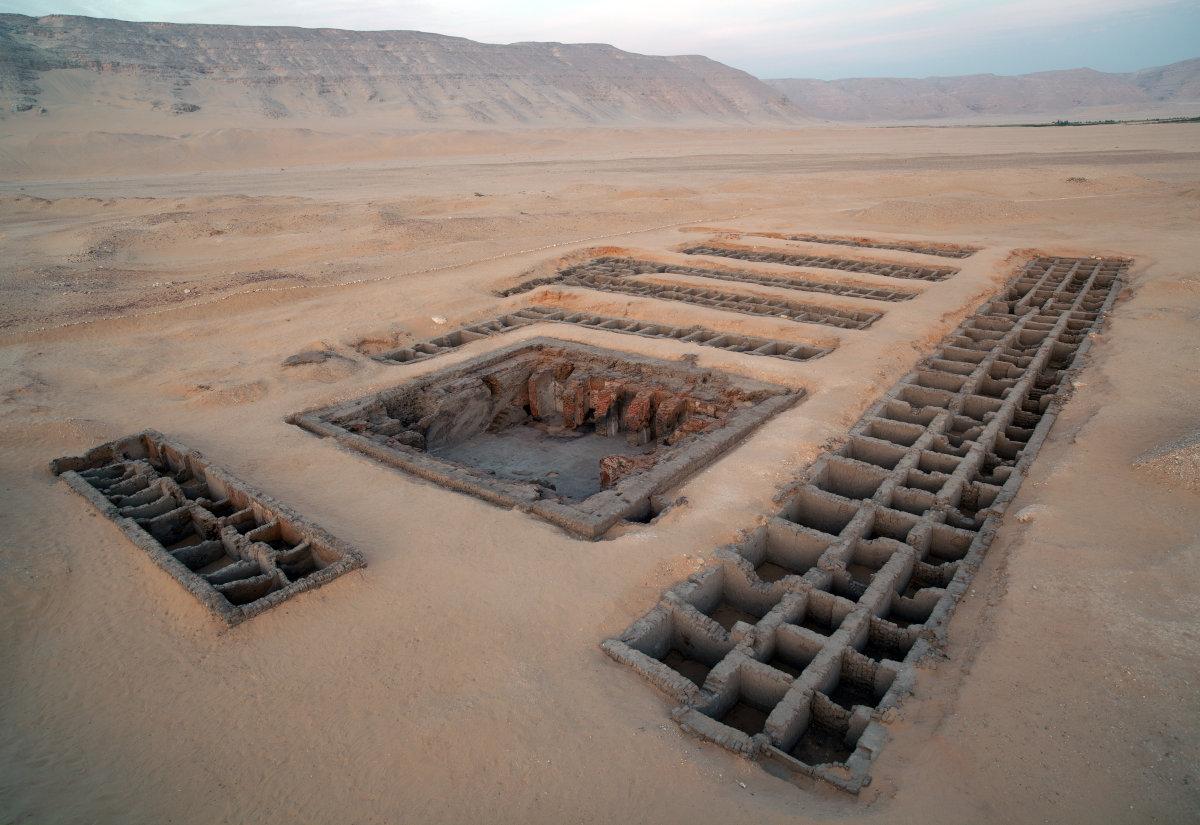
One of the most important monuments associated with Djer is his tomb at Umm el-Qa'ab, near Abydos in Upper Egypt.
The royal cemetery at Umm el-Qa'ab contains the tombs of many early Egyptian kings.
Djer's tomb is one of the largest and most significant monuments in the cemetery.
It consists of a large central burial chamber surrounded by numerous smaller chambers.
The size and complexity of the tomb demonstrate the growing power of the Egyptian monarchy.
The royal tomb was designed not only to protect the king's body but also to support his existence in the afterlife.
The Tomb and Subsidiary Burials
One of the most interesting features of Djer's tomb is the large number of subsidiary burials surrounding it.
Archaeologists discovered many graves near the main burial chamber.
These burials have created considerable debate among historians.
Some scholars believe that the people buried around the royal tomb may have been servants or members of the royal household who were buried to accompany the king into the afterlife.
This practice is sometimes described as retainer sacrifice.
However, the exact nature of these burials remains uncertain.
They may also have had symbolic or ceremonial purposes.
Regardless of the interpretation, the large number of subsidiary graves demonstrates the extraordinary importance of the king's afterlife during the First Dynasty.
The Royal Cemetery at Abydos
Abydos became one of the most sacred places in ancient Egypt.
The area of Umm el-Qa'ab was used as a royal cemetery during the earliest dynasties.
Later Egyptians associated Abydos with Osiris, the god of the dead and ruler of the afterlife.
Because of this religious connection, Abydos remained an important pilgrimage center for thousands of years.
The tombs of early kings were therefore located in a place that would eventually become one of Egypt's most important religious landscapes.
Djer's tomb is an important part of this long history.
Djer and Egyptian Religion
Religion played a central role in Djer's reign.
The ancient Egyptians believed that the king had a special relationship with the gods.
Horus was particularly important because the living king was associated with him.
After death, the king was connected with Osiris.
This religious system provided the foundation for royal funerary traditions.
The king's tomb was a place where offerings and rituals could continue after his death.
The survival of the royal cult was considered essential for the king's eternal existence.
Djer's large burial complex demonstrates how important these beliefs had already become during the First Dynasty.
Early Egyptian Writing
Djer's reign also provides evidence about the development of Egyptian writing.
The early dynastic period was a time when hieroglyphic writing was becoming increasingly useful for administrative and ceremonial purposes.
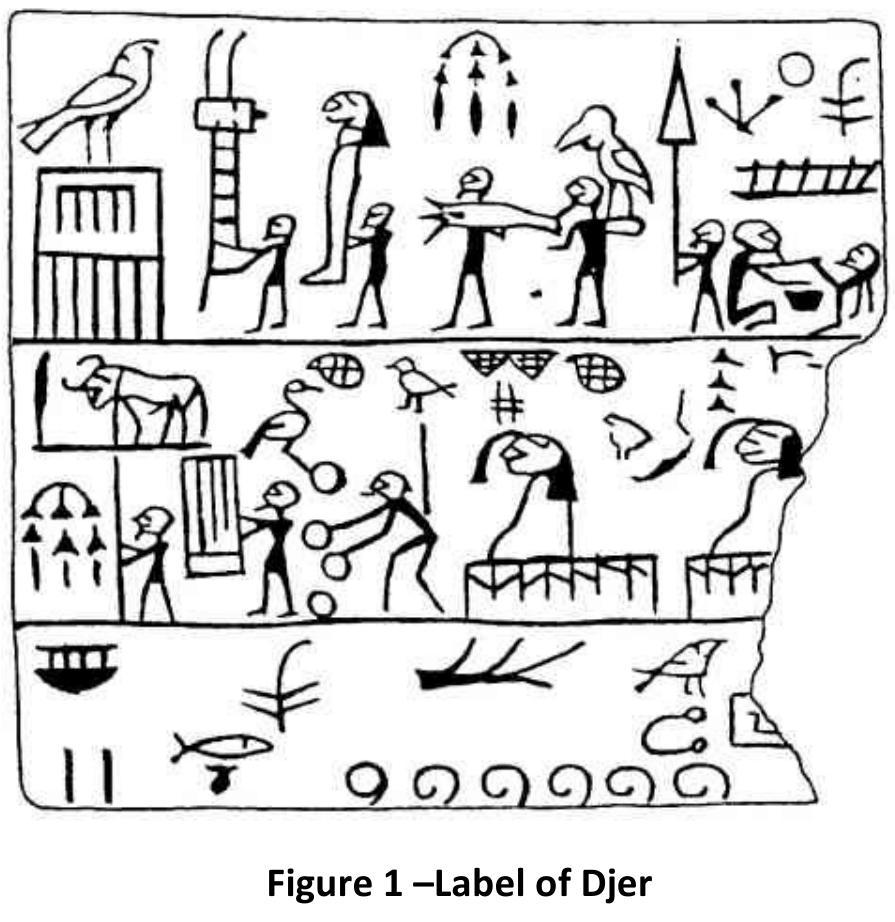
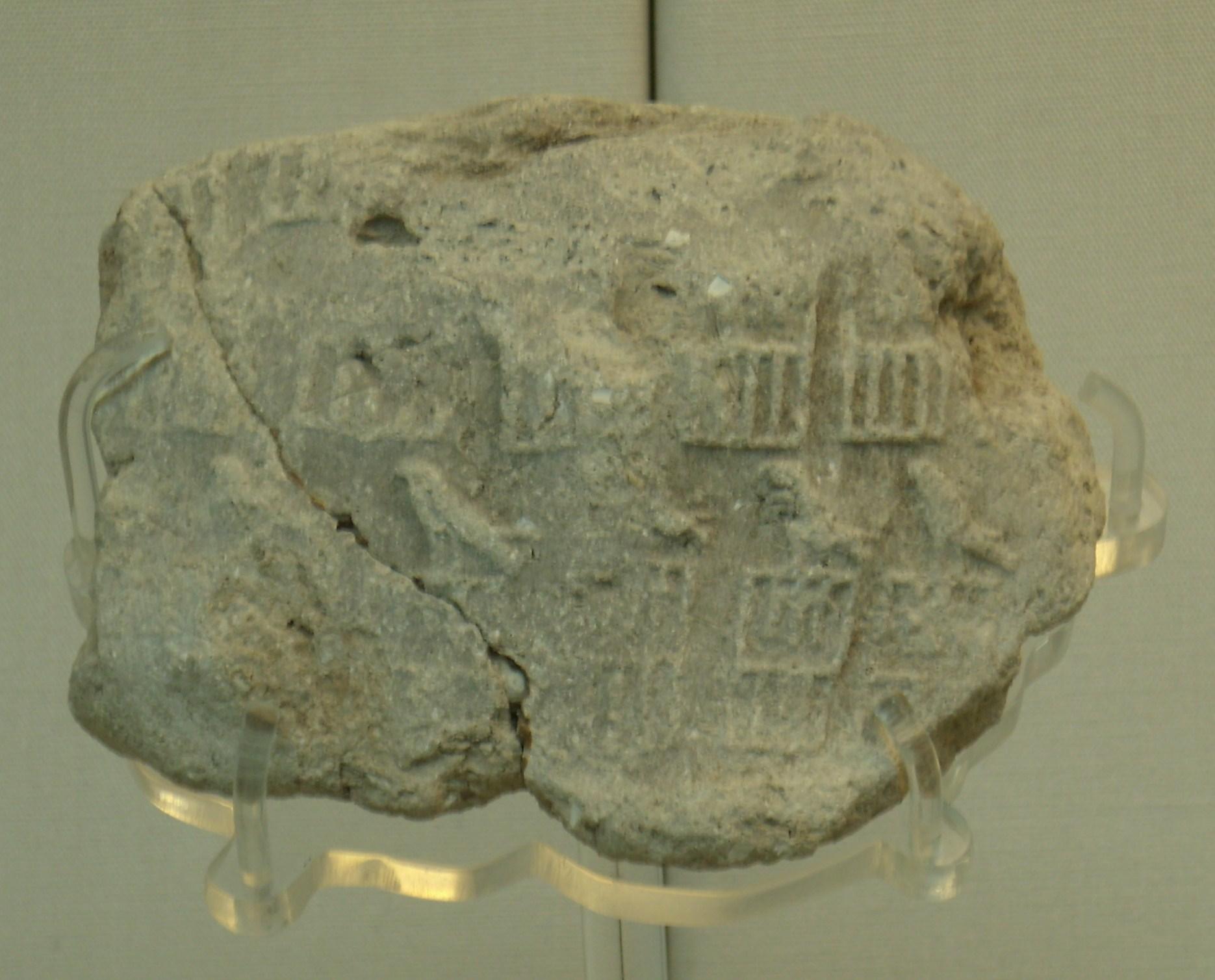
Ivory labels, stone objects, pottery inscriptions, and seal impressions provide important information about royal activities.
These inscriptions were generally short and did not provide detailed historical narratives.
Instead, they recorded names, products, places, ceremonies, and other information.
Over time, Egyptian writing would develop into a sophisticated system capable of recording religious texts, literature, legal documents, historical events, and personal letters.
Djer ruled during the early stages of this development.
Ivory Labels and Royal Records
Small ivory labels associated with Djer are among the important archaeological objects from his reign.
These labels may have been attached to containers or other goods.
They provide evidence of the administrative system used by the early Egyptian state.
The ability to identify products, shipments, royal estates, and ceremonies was essential for a centralized government.
Although the inscriptions are often difficult to interpret, they demonstrate that the royal administration was already sophisticated.
Djer's reign therefore contributes to our understanding of how the Egyptian state managed its economy.
Egypt's Economy
Agriculture was the foundation of the Egyptian economy.
The Nile provided fertile soil and allowed farmers to produce large quantities of grain and other crops.
The central government could collect part of this agricultural production and redistribute it to officials, soldiers, priests, craftsmen, and workers.
The palace and temples also controlled large estates.
This economic system allowed the monarchy to support major construction projects and religious ceremonies.
During Djer's reign, the Egyptian state was becoming increasingly capable of organizing and redistributing resources.
Trade and Foreign Relations
Egypt's location gave it access to several important trade routes.
The early Egyptians interacted with neighboring regions including Nubia, Sinai, the Eastern Desert, and the Levant.
These regions provided resources that were limited or unavailable in Egypt.
Trade and expeditions could bring stone, minerals, timber, oils, and luxury goods.
Djer's reign belongs to a period when Egypt was developing stronger connections with neighboring lands.
Archaeological evidence suggests that the early dynastic kings were already involved in long-distance exchange and expeditions.
These activities helped increase the wealth and power of the Egyptian monarchy.
Djer's Military Activities
The early Egyptian kings needed to protect the newly unified kingdom.
Although detailed records of Djer's military campaigns are limited, archaeological and historical evidence suggests that early dynastic rulers conducted expeditions beyond Egypt.
The Egyptian state was particularly interested in regions that provided valuable resources.
Military expeditions could also help secure trade routes and reinforce royal authority.
Later Egyptian kings would develop much more detailed military records.
Djer's reign belongs to the early stage of this tradition.
Djer and the Sinai Peninsula
One area of particular importance to early Egyptian rulers was the Sinai Peninsula.
Sinai contained valuable mineral resources, especially copper and turquoise.
Egyptian expeditions traveled into the region to obtain these materials.
The presence of Egyptian inscriptions and artifacts in Sinai demonstrates that the early monarchy had interests beyond the Nile Valley.
Such expeditions required planning, transportation, workers, and protection.
Their existence shows the organizational capabilities of the early Egyptian state.
The King's Afterlife
The ancient Egyptians believed that death was a transition rather than an end.
The king was expected to continue his existence in the divine world.
The royal burial complex was therefore designed as a place where the deceased ruler could receive offerings and maintain his eternal identity.
Djer's tomb was large enough to support an extensive funerary cult.
Food, vessels, tools, and other objects could be associated with the burial.
The complexity of the tomb demonstrates that royal afterlife beliefs were already deeply established during the First Dynasty.
These beliefs would eventually lead to the construction of enormous pyramids.
Djer's Tomb and the Development of Royal Architecture
Djer's tomb is important because it represents an early stage in the development of Egyptian royal architecture.
At this time, Egyptian kings were not yet building the massive stone pyramids that would later dominate the landscape.
Instead, royal tombs consisted of underground chambers surrounded by mud-brick structures.
Over several generations, these burial traditions evolved.
The Third Dynasty introduced the Step Pyramid of Djoser.
The Fourth Dynasty produced the great pyramids of Sneferu, Khufu, Khafre, and Menkaure.
Djer's tomb therefore belongs to the early foundations of this architectural tradition.
Djer's Historical Importance
Djer's importance lies in his position within the early development of the Egyptian state.
He ruled after the initial unification of the country and helped maintain the traditions of the First Dynasty.
His reign demonstrates that the unified monarchy was becoming stable enough to support large royal projects and complex administration.
The evidence from his tomb and associated objects shows the growing importance of royal religion, writing, economic organization, and centralized authority.
These developments would shape Egypt for thousands of years.
Djer's Legacy
Djer was remembered in later Egyptian traditions as one of the early kings of the First Dynasty.
His tomb remained an important monument at Abydos.
Centuries later, the area became associated with Osiris and attracted pilgrims from across Egypt.
The religious importance of Abydos helped preserve the memory of the early kings buried there.
Djer's name may not be as familiar to modern visitors as the names of Tutankhamun or Ramesses II, but his reign represents an important chapter in the formation of Egyptian civilization.
From Djer to the Pyramids
The history of Djer demonstrates how Egyptian civilization developed gradually.
The earliest dynastic kings established political unity.
They developed administrative systems and strengthened royal authority.
They created religious traditions connecting the king with the gods.
They established royal cemeteries and increasingly elaborate tombs.
These developments created the foundations for the later Old Kingdom.
Centuries after Djer's death, Egyptian architects would transform the royal tomb into the monumental pyramid.
The Step Pyramid of Djoser was the first great example of this transformation.
The pyramids of Giza followed soon afterward.
Djer was therefore part of the long historical process that eventually produced these famous monuments.
Conclusion
Djer was one of the earliest pharaohs of ancient Egypt and is generally considered the third king of the First Dynasty.
He ruled during a crucial period when Egypt was developing into a centralized and powerful kingdom.
His reign followed the establishment of political unity between Upper and Lower Egypt and helped strengthen the traditions of early pharaonic rule.
Djer's tomb at Abydos is one of the most important archaeological remains from the First Dynasty.
Its size, structure, and surrounding burials demonstrate the growing importance of royal power and the afterlife.
Archaeological objects such as ivory labels and seal impressions provide evidence of an increasingly sophisticated administrative system.
Djer's reign also belongs to a period of growing trade, resource expeditions, religious development, and royal organization.
Although few written records survive, the archaeological evidence reveals a kingdom that was already developing many of the characteristics that would define ancient Egypt.
Djer lived thousands of years before the pyramids of Giza and the temples of the New Kingdom.
Yet his reign was part of the foundation upon which those later achievements were built.
Djer was one of the early kings who helped transform the newly unified Egyptian kingdom into a stable civilization, beginning a royal tradition that would continue for more than three thousand years.