Djedefre was an important pharaoh of ancient Egypt's Fourth Dynasty, best known as the son and successor of Khufu, the builder of the Great Pyramid of Giza. His reign took place during the Old Kingdom, a period when Egypt was at the height of its political organization, royal power, and monumental architecture.
Although Djedefre's reign was relatively short, he left an important mark on Egyptian history. Unlike his father, who built the Great Pyramid at Giza, Djedefre chose Abu Rawash, north of Giza, as the location for his royal pyramid.
His pyramid is now largely ruined, but archaeological discoveries have revealed fascinating statues, fragments, architectural remains, and evidence of royal religious traditions.
Who Was Djedefre?
Djedefre was the son of Khufu, one of the most famous pharaohs in Egyptian history.
Khufu ruled Egypt during the Fourth Dynasty and commissioned the Great Pyramid of Giza.
Djedefre succeeded Khufu after his death.
His ancient Egyptian name is commonly interpreted as something like “Enduring Like Re” or “His Endurance Is Re.”
The name contains the name of Ra, the powerful sun god who became increasingly important during the Fourth Dynasty.
This connection with Ra was significant.
Royal ideology increasingly associated the pharaoh with the sun god and the eternal solar cycle.
Djedefre's Place in the Fourth Dynasty
The Fourth Dynasty was famous for its monumental pyramids.
Sneferu, Khufu, Djedefre, and Khafre were all connected with some of the most important pyramid projects of the Old Kingdom.
Sneferu experimented with pyramid construction at Meidum and Dahshur.
Khufu built the Great Pyramid.
Djedefre built his pyramid at Abu Rawash.
Khafre later built the second great pyramid at Giza.
Together, these rulers transformed Egyptian architecture.
The Succession After Khufu
The succession after Khufu is not completely understood.
Djedefre became king after Khufu, but historians continue to debate the exact family relationships and political circumstances surrounding the transition.
Some ancient and modern theories have suggested possible conflicts within the royal family.
However, the evidence is insufficient to establish a dramatic succession struggle with certainty.
Djedefre was clearly a legitimate member of the royal family and became pharaoh during an important period in Egyptian history.
Abu Rawash
One of Djedefre's most important decisions was choosing Abu Rawash as the location for his pyramid.
Abu Rawash is located approximately 8 kilometers north of the Giza Plateau.
The site overlooks an important area of the Nile Valley.
The location may have provided several advantages.
It was close enough to the Memphis region to remain connected with the royal administrative center.
At the same time, the elevated landscape provided a prominent position for a royal monument.
Djedefre's Pyramid
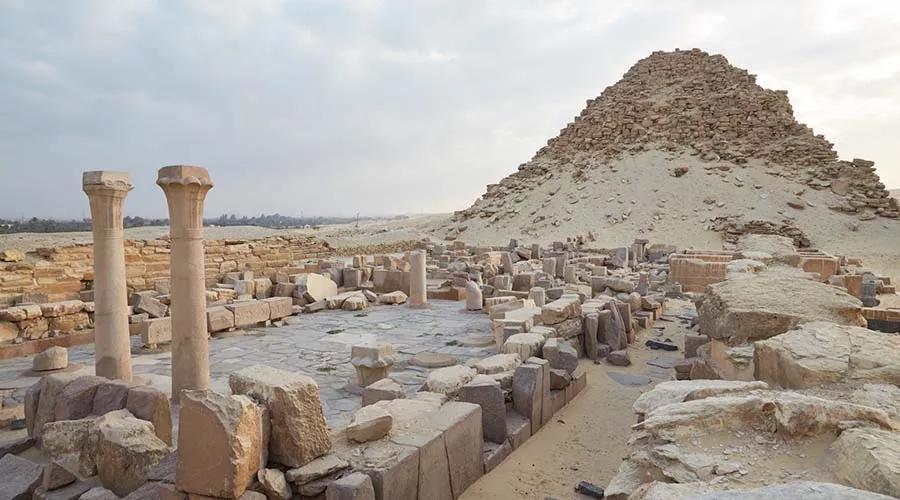
Djedefre's pyramid was originally much larger than the ruins visible today suggest.
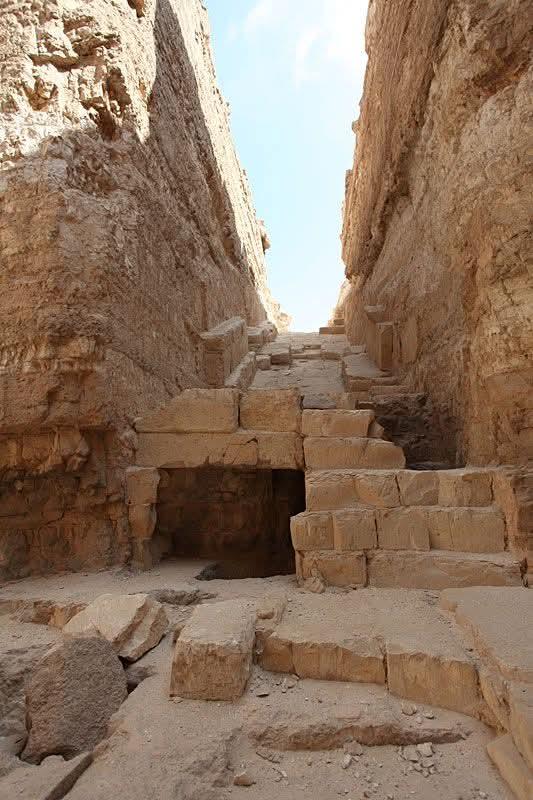
The monument was constructed on a natural rocky elevation.
Its builders incorporated the natural landscape into the design.
The pyramid was probably covered with polished limestone.
Some evidence suggests that granite was also used in parts of the complex.
Over thousands of years, much of the structure disappeared.
Stone from the site was reused in later construction.
Weathering and natural erosion also contributed to the destruction.
As a result, the pyramid is now dramatically different from its original appearance.
Why Did Djedefre Choose Abu Rawash?
The reason Djedefre chose Abu Rawash remains uncertain.
Several explanations have been proposed.
One possibility is that the location had religious significance.
Another possibility is that Djedefre wanted to establish a separate royal monument away from the Giza complex.
The site also offered a natural elevation that could make the pyramid appear taller and more impressive.
There is no definitive evidence identifying a single reason.
Djedefre and the Sun God Ra
Djedefre's name contains the element Re, referring to Ra.
This is significant because the worship of Ra became increasingly important during the Fourth Dynasty.
The pharaoh's connection to the sun was central to royal ideology.
The king was associated with the daily journey of the sun.
At death, the king was believed to join the divine world and continue his eternal existence.
Djedefre's name may therefore have expressed his connection with solar kingship.
The First King to Use “Son of Ra”?
Djedefre is often associated with an important development in royal titulary.
The title “Son of Ra” became increasingly prominent in later Egyptian kingship.
Some evidence suggests that Djedefre may have been among the earliest rulers to use this title.
This development was extremely important.
For thousands of years afterward, Egyptian kings would identify themselves as sons of Ra.
The title emphasized the divine origin and legitimacy of the pharaoh.
Statues of Djedefre
Archaeologists discovered several fragments of statues associated with Djedefre at Abu Rawash.
Some of these sculptures show the king wearing traditional royal crowns.
Other fragments depict members of the royal family.
The sculptures provide valuable information about Fourth Dynasty artistic traditions.
The quality of the work demonstrates the high level of Egyptian craftsmanship during the period.
The Sphinxes of Djedefre
Fragments of sphinx sculptures have also been discovered at Abu Rawash.
The sphinx was a powerful royal symbol.
It combined the body of a lion with a human or royal head.
The lion represented strength and royal power.
The sphinx therefore symbolized the king's ability to protect sacred places and defeat enemies.
Djedefre's association with sphinx imagery is especially interesting because it adds to the broader development of this royal symbol during the Fourth Dynasty.
Djedefre and the Great Sphinx
The Great Sphinx of Giza is traditionally associated with Khafre, Djedefre's successor or close royal relative.
However, Djedefre's use of sphinx imagery at Abu Rawash demonstrates that the concept was already part of royal symbolism during his reign.
The exact development of sphinx imagery during the Fourth Dynasty remains an important area of Egyptological research.
Djedefre's Family
Djedefre married members of the royal family.
One important woman associated with him was Hetepheres II, who was a daughter of Khufu.
Their marriage would have strengthened Djedefre's position within the royal family.
Hetepheres II lived for a remarkably long time by ancient Egyptian standards.
She was associated with several important royal generations.
Other members of Djedefre's family included princes and princesses whose names appear in archaeological evidence.
Queen Hetepheres II
Hetepheres II is one of the most fascinating women of the Fourth Dynasty.
She was connected to several generations of the royal family.
Her life probably extended from the reign of Khufu through later Fourth Dynasty rulers.
She was involved in royal funerary traditions and appears to have held an important position at court.
Her connection with Djedefre provides another link between the royal family of Khufu and the later rulers of the dynasty.
Djedefre's Reign
The exact length of Djedefre's reign is uncertain.
Traditional reconstructions often give him a relatively short reign, perhaps around eight years.
However, some evidence has led scholars to suggest that he may have ruled longer.
The limited number of surviving monuments makes it difficult to determine the exact chronology.
Even during a relatively short reign, however, Djedefre was able to organize a major pyramid project and maintain royal authority.
Administration and Labor
The construction of Djedefre's pyramid required a strong administrative system.
Stone had to be quarried and transported.
Workers needed food, water, tools, and housing.
Officials had to organize labor teams.
Craftsmen produced architectural elements, statues, and ceremonial objects.
The project therefore demonstrates the continuing strength of the Egyptian state after Khufu.
Trade and Resources
Djedefre's government relied on Egypt's extensive resource network.
Granite could be transported from Aswan.
Limestone was available from several quarries in Egypt.
Copper and turquoise could be obtained from the Sinai region.
Other materials came through trade with neighboring territories.
The royal administration had to coordinate these resources to maintain the pyramid project and other state activities.
Religion and the Afterlife
For Djedefre, as for other Egyptian kings, death was not considered the end.
The pharaoh was expected to continue his existence in the divine world.
Funerary rituals were designed to preserve the king's body and provide spiritual support.
Offerings of food, drink, incense, and other materials were presented to the deceased ruler.
The pyramid complex functioned as a center for these rituals.
The king's eternal existence was closely connected with the religious ideology of kingship.
The Pyramid Complex
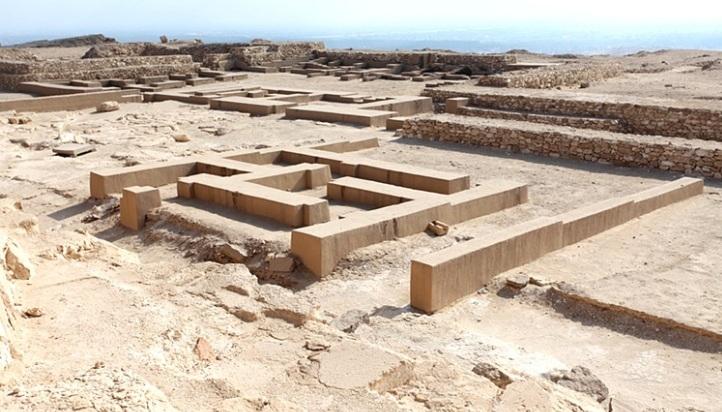
Djedefre's pyramid complex probably included several important elements.
These included the pyramid itself, a mortuary temple, causeways, subsidiary structures, and areas for religious activity.
The complex would have supported the rituals required for the king's afterlife.
Although much of the complex has been destroyed, archaeological excavations have revealed enough remains to reconstruct parts of its original design.
The Destruction of the Pyramid
Djedefre's pyramid suffered significant destruction over the centuries.
Large quantities of stone were removed from the site.
Some blocks were reused in later buildings.
The exposed core of the pyramid was also affected by weathering.
As a result, the monument is now mostly a large archaeological ruin.
Nevertheless, the remaining foundations and fragments reveal the impressive scale of the original project.
Abu Rawash Today
Today, Abu Rawash is an important archaeological site.
The ruins of Djedefre's pyramid provide researchers with information about Fourth Dynasty architecture.
Archaeologists continue to study the site to understand how the pyramid was constructed and how the complex functioned.
The location is particularly valuable because it preserves evidence of a royal pyramid outside the better-known Giza complex.
Djedefre and Khafre
After Djedefre, Khafre became king.
Khafre built the second-largest pyramid at Giza.
His monument remains much better preserved than Djedefre's pyramid.
Khafre's pyramid still retains some of its original limestone casing near the summit.
His funerary complex is also traditionally associated with the Great Sphinx.
The contrast between the surviving Giza monuments and the ruined pyramid at Abu Rawash demonstrates how dramatically ancient monuments could change over time.
Djedefre's Place in History
Djedefre is sometimes overlooked because his father Khufu and successor Khafre are much more famous.
However, he played an important role in the history of the Fourth Dynasty.
He continued the tradition of monumental royal construction.
He strengthened the solar aspects of Egyptian kingship.
He introduced or reinforced important royal titles.
He created a major royal complex at Abu Rawash.
He also left behind some remarkable examples of Fourth Dynasty sculpture.
Why Djedefre Matters
Djedefre matters because his reign reveals the complexity of the Fourth Dynasty.
The dynasty was not simply a succession of pyramid builders.
The kings were developing new religious ideas, royal titles, artistic traditions, and political strategies.
Djedefre's choice of Abu Rawash demonstrates that royal architecture could take different forms and locations.
His association with Ra shows the growing importance of solar religion.
His statues and sphinx fragments reveal the sophistication of Egyptian royal art.
Conclusion
Djedefre was an important pharaoh of Egypt's Fourth Dynasty and the son of Khufu, builder of the Great Pyramid of Giza.
His reign came during one of the most powerful periods of ancient Egyptian history.
Unlike his father, Djedefre chose Abu Rawash as the location for his royal pyramid.
Although the pyramid has suffered extensive destruction, archaeological remains show that it was once an impressive royal monument.
Djedefre's reign is also significant for the development of Egyptian solar kingship.
His name incorporated Ra, and he is associated with the early use of the title “Son of Ra,” a royal title that became fundamental to Egyptian kingship in later centuries.
The discovery of statues and sphinx fragments at Abu Rawash provides further evidence of his royal ideology and artistic traditions.
Djedefre's family connections also place him at the heart of the Fourth Dynasty.
His relative Khafre later constructed another great pyramid at Giza, while the royal family continued to dominate Egypt.
Although Djedefre's pyramid is no longer standing in its original form, his archaeological legacy remains important.
Djedefre represents a fascinating chapter between the Great Pyramid of Khufu and the monuments of Khafre. His reign demonstrates how Egyptian kings continued to experiment with architecture, religion, and royal symbolism during the golden age of pyramid building.