Sneferu was one of the most important pharaohs of Egypt's Fourth Dynasty and one of the greatest builders of the Old Kingdom. He ruled during the 26th century BCE and transformed Egyptian royal architecture.
Before Sneferu, Egyptian kings had built monumental tombs and experimented with pyramid-shaped structures. Sneferu took these experiments to an entirely new level. During his reign, Egyptian architects developed techniques that eventually produced the true pyramid, creating the architectural foundation for the Great Pyramid of Giza.
Sneferu is associated with three major pyramid projects: the Meidum Pyramid, the Bent Pyramid, and the Red Pyramid at Dahshur. Together, these monuments reveal the extraordinary architectural experimentation that took place during his reign.
Who Was Sneferu?
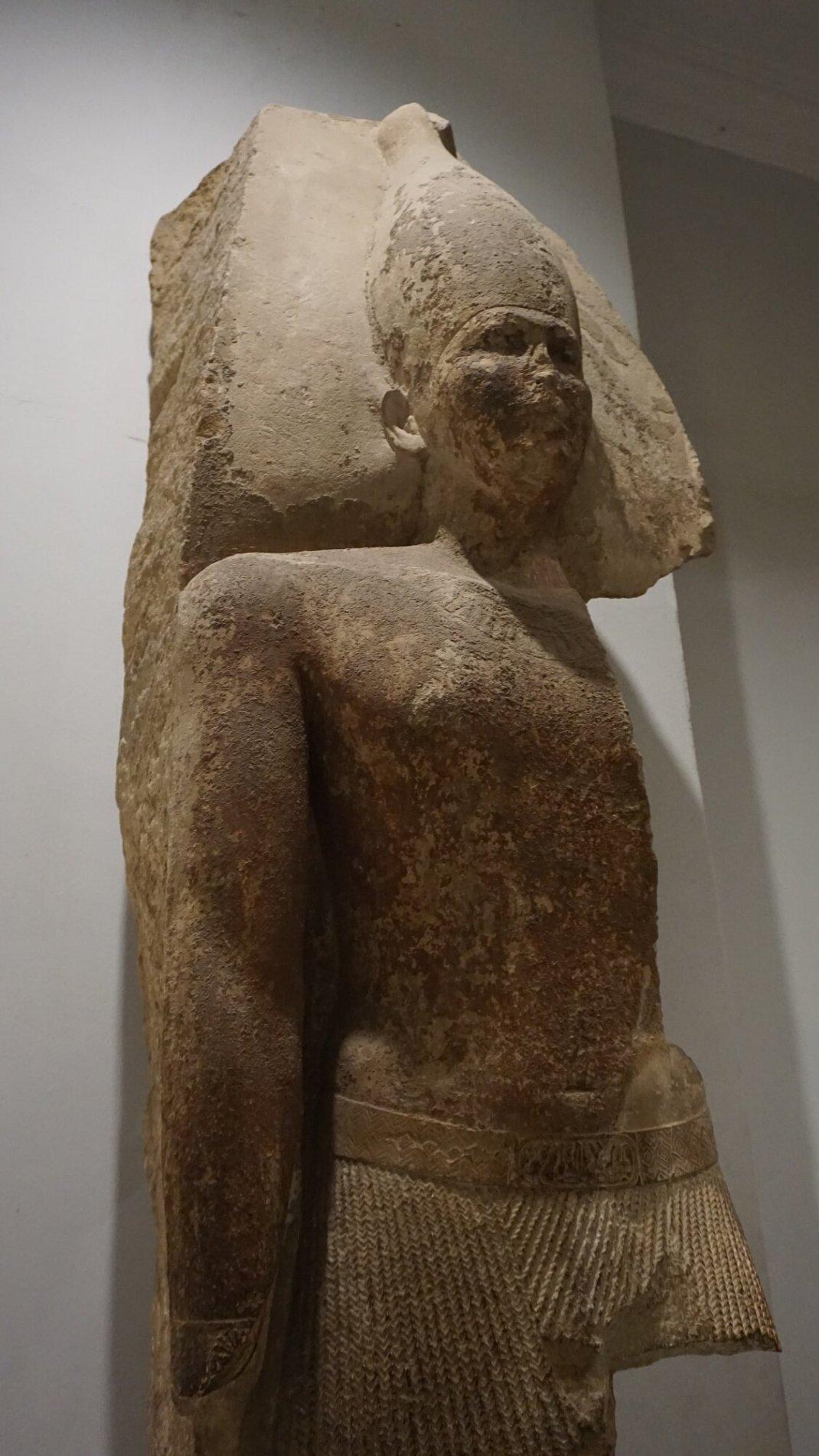
Sneferu was the founder of the Fourth Dynasty of ancient Egypt.
His name is usually translated as something like “He Who Has Been Made Beautiful” or “He Who Makes Beautiful.”
He became king after the end of the Third Dynasty.
Sneferu was probably the son of Huni, the last ruler of the Third Dynasty, although the exact family relationships remain debated.
His mother may have been Meresankh I.
Sneferu married Hetepheres I, who was probably the daughter of Huni.
Their son was Khufu, the famous builder of the Great Pyramid at Giza.
This made Sneferu an important ancestor of one of Egypt's most famous royal families.
The Beginning of the Fourth Dynasty
When Sneferu became king, Egypt was already a powerful centralized kingdom.
The Third Dynasty had established important traditions of monumental construction.
Djoser's Step Pyramid at Saqqara demonstrated that Egyptian architects could build enormous structures from stone.
Sneferu inherited this architectural tradition but pushed it much further.
His reign transformed the royal tomb from a stepped monument into a smooth-sided pyramid.
This development became the defining architectural achievement of the Fourth Dynasty.
Sneferu and the Pyramid of Meidum
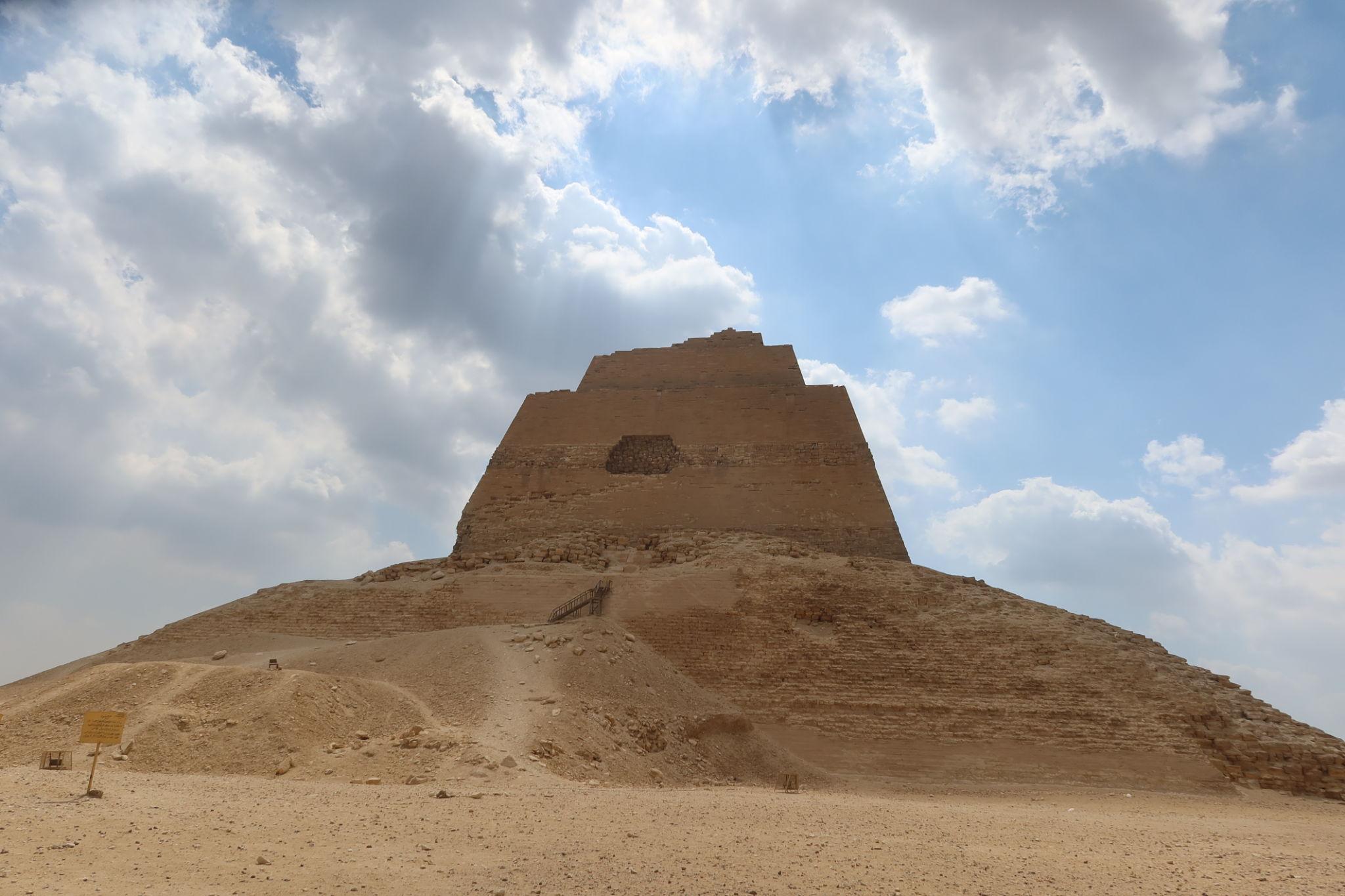
The Meidum Pyramid is one of the most fascinating monuments associated with Sneferu.
The pyramid was originally constructed as a stepped pyramid.
Later, its design was changed.
The builders attempted to fill the steps and create smooth outer sides.
This was an important experiment in pyramid construction.
Today, much of the outer casing has disappeared, leaving the distinctive core structure that gives the monument its unusual appearance.
There is debate about how much of the monument was constructed during Sneferu's reign and how much may have been begun under Huni.
Nevertheless, Sneferu is strongly associated with its transformation into a true pyramid.
The Bent Pyramid at Dahshur
Sneferu's next major architectural project was the Bent Pyramid at Dahshur.
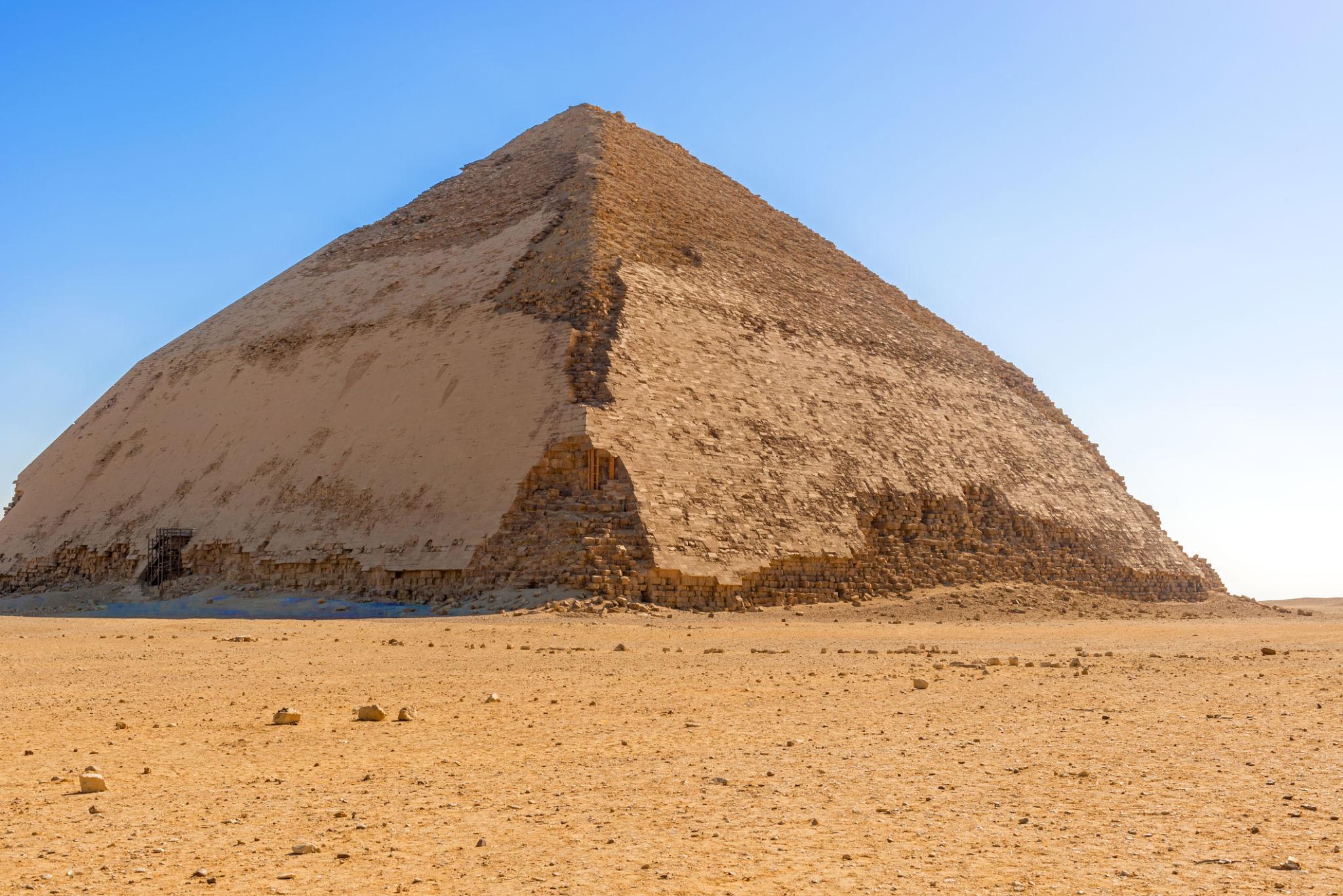
The Bent Pyramid is one of the most recognizable pyramids in Egypt.
Its lower section has a steep angle.
However, halfway toward the top, the angle changes.
This creates the unusual “bent” appearance.
The reason for the change remains debated.
One possibility is that the builders became concerned about the structural stability of the pyramid.
The steep lower angle may have placed too much pressure on the structure.
By reducing the angle, the architects could make the upper section more stable.
The Bent Pyramid therefore provides extraordinary evidence of Egyptian engineering experimentation.
A Major Architectural Experiment
The Bent Pyramid is important because it preserves much of its original limestone casing.
Unlike many other pyramids, its outer surface still provides a clear impression of what a finished pyramid looked like.
The polished limestone would have reflected sunlight.
The monument would have appeared bright and almost shining beneath the Egyptian sun.
The pyramid's original appearance helps modern historians understand how the great pyramids of later generations were designed.
The Red Pyramid
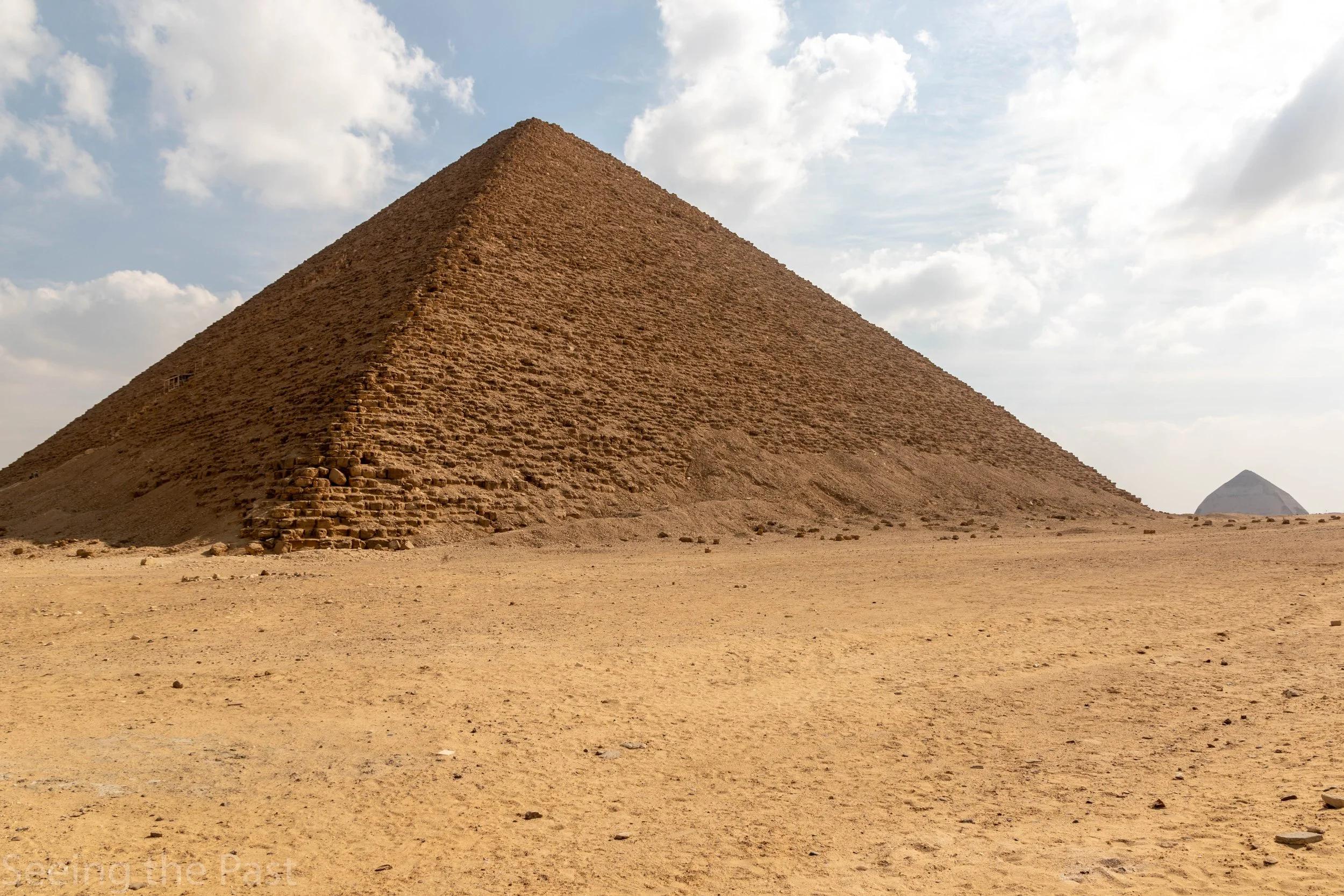
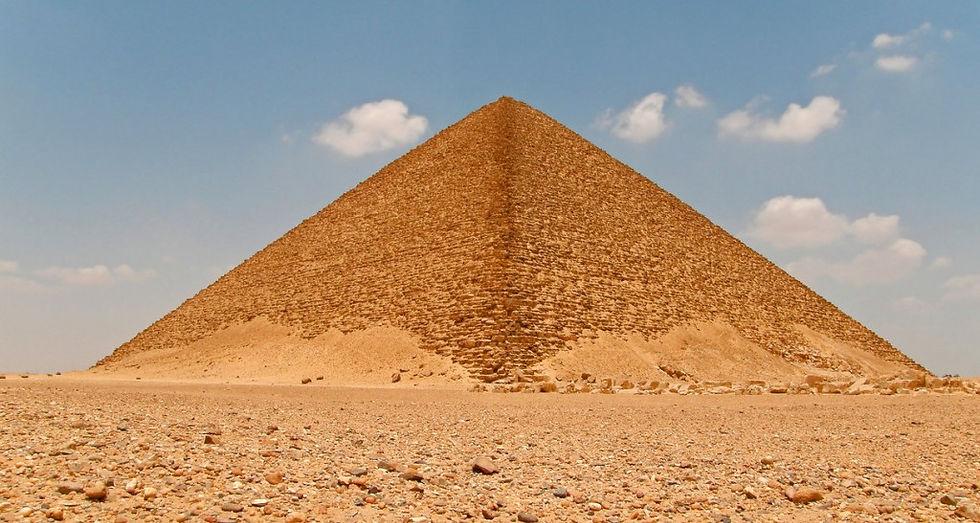
Sneferu's final major pyramid project was the Red Pyramid, also known as the North Pyramid of Dahshur.
The Red Pyramid is generally considered the first successful true smooth-sided pyramid.
Its sides rise at a relatively moderate angle.
Unlike the Bent Pyramid, the Red Pyramid maintains the same slope from the base to the top.
The pyramid gets its modern name from the reddish color of its limestone core.
The achievement was enormous.
Egyptian architects had finally developed a stable design for a large smooth-sided pyramid.
The First True Pyramid
The Red Pyramid represents a turning point in Egyptian architecture.
Earlier pyramids had experimented with stepped forms and changing angles.
Sneferu's Red Pyramid demonstrated that a large, stable, smooth-sided pyramid could be constructed.
This design would influence the pyramids of the next generation.
Sneferu's son Khufu would later build the Great Pyramid at Giza.
The architectural knowledge gained during Sneferu's reign almost certainly contributed to the success of Khufu's enormous monument.
Sneferu's Building Program
Sneferu's architectural achievements were not limited to pyramids.
His reign included temples, royal estates, administrative buildings, and other construction projects.
Building on such a scale required enormous resources.
Stone had to be quarried.
Workers had to transport blocks.
Food and tools had to be supplied.
Officials had to organize thousands of laborers and craftsmen.
The success of these projects demonstrates the extraordinary organizational strength of the Egyptian state.
The Egyptian Economy Under Sneferu
Sneferu ruled during a period of economic strength.
Egypt's economy depended heavily on agriculture.
The annual Nile flood created fertile land.
Farmers cultivated wheat, barley, flax, vegetables, and fruit.
The government collected part of the agricultural surplus.
These resources supported the royal court, temples, officials, soldiers, craftsmen, and workers.
The centralized economy allowed Sneferu to maintain a huge building program.
Trade and Expeditions
Sneferu also organized expeditions beyond Egypt.
Egypt needed resources that were not readily available in the Nile Valley.
Copper and turquoise were obtained from the Sinai Peninsula.
Stone and minerals came from the Eastern Desert.
Egypt also maintained contact with Nubia and regions farther south.
One famous inscription from Sneferu's reign describes a military or trading expedition to Nubia.
The records suggest that thousands of people and large numbers of cattle were brought back to Egypt.
Such expeditions demonstrate the military and administrative power of the Egyptian state.
Sneferu and the Sinai
The Sinai Peninsula was particularly important because of its copper and turquoise resources.
Egyptian expeditions traveled into the region to obtain these valuable materials.
Copper was essential for tools and weapons.
Turquoise was highly valued for jewelry and religious objects.
The ability to organize expeditions into remote desert areas demonstrates the logistical abilities of Sneferu's government.
Sneferu and Nubia
Nubia was another important region for Egypt.
The area south of Egypt provided access to trade routes, minerals, animals, and other resources.
Sneferu's reign saw Egyptian military and economic activity in Nubia.
The relationship between Egypt and Nubia was not always peaceful.
Trade, diplomacy, military campaigns, and resource extraction all played a role.
Sneferu's government sought to protect Egypt's southern interests and maintain access to valuable resources.
Sneferu's Military Power
Sneferu was not only a builder.
Later Egyptian traditions remembered him as a powerful king.
Evidence from his reign indicates military activity in neighboring regions.
Egypt needed a strong military to protect trade routes and secure resources.
The king's role included defending Egypt and maintaining order.
Sneferu's successful expeditions helped strengthen the economic foundation of his building projects.
Sneferu and the Egyptian Gods
Religion was central to Sneferu's kingship.
The pharaoh was considered a divine ruler and the son or representative of the gods.
The sun god Ra became increasingly important during the Fourth Dynasty.
Sneferu's royal ideology emphasized his connection with divine power.
His pyramids were not simply tombs.
They were part of enormous religious complexes designed to support the king's eternal existence.
The Pyramid Complex
A pyramid complex typically included more than the pyramid itself.
There was usually a valley temple, a causeway, a mortuary temple, and other structures.
The valley temple was connected with the Nile and served as an entrance to the complex.
The causeway connected the valley temple with the upper complex.
The mortuary temple was used for rituals and offerings.
These architectural elements became increasingly sophisticated during the Fourth Dynasty.
Sneferu's Family
Sneferu's family became one of the most important royal families in Egyptian history.
His wife Hetepheres I was the mother of Khufu according to widely accepted interpretations.
Khufu later became the builder of the Great Pyramid.
Sneferu's other children included important royal family members and officials.
His descendants ruled Egypt for generations.
The Fourth Dynasty became famous for monumental construction and strong royal authority.
Hetepheres I
Hetepheres I is particularly famous because of her burial equipment.
Her tomb was discovered near the Great Pyramid complex at Giza.
Although the tomb had been robbed, archaeologists discovered an extraordinary collection of objects.
These included furniture, jewelry, and ceremonial items.
The discovery provides valuable information about royal life during the Fourth Dynasty.
Hetepheres' connection with Sneferu and Khufu makes her one of the most important women of the Old Kingdom.
Sneferu's Character in Ancient Tradition
Ancient Egyptian texts sometimes portray Sneferu as an ideal king.
Later stories describe him as a successful and generous ruler.
The famous Westcar Papyrus, written many centuries after Sneferu's reign, presents stories about the royal court.
Although the stories are literary rather than historical records, they show that Sneferu's reputation survived long after his death.
He became remembered as a wise and powerful ruler.
Sneferu's Legacy
Sneferu's greatest legacy is architecture.
His reign produced three extraordinary pyramid projects.
The Meidum Pyramid represents experimentation.
The Bent Pyramid represents adaptation and engineering innovation.
The Red Pyramid represents the successful creation of a true smooth-sided pyramid.
Together, they show the rapid development of Egyptian pyramid architecture.
Sneferu therefore deserves an important place in the history of ancient engineering.
Sneferu and Khufu
Sneferu's son Khufu continued the architectural tradition established by his father.
Khufu constructed the Great Pyramid of Giza, the largest pyramid ever built in ancient Egypt.
The Great Pyramid would become one of the Seven Wonders of the Ancient World.
The relationship between Sneferu and Khufu demonstrates how knowledge and expertise could pass from one generation to another.
Sneferu's experiments helped create the technical foundation for Khufu's monumental achievement.
Why Sneferu Matters
Sneferu was more than a pyramid builder.
His reign demonstrates the power of the Old Kingdom state.
Large construction projects required organization, taxation, agriculture, trade, engineering, and administration.
His expeditions demonstrate Egypt's ability to operate beyond the Nile Valley.
His family established one of the most famous royal dynasties in Egyptian history.
Most importantly, his architectural experiments changed the future of Egyptian civilization.
Conclusion
Sneferu was one of the greatest builders and most important rulers of ancient Egypt.
As the founder of the Fourth Dynasty, he ruled during a period of extraordinary political and architectural development.
His reign is associated with the Meidum Pyramid, the Bent Pyramid, and the Red Pyramid at Dahshur.
These monuments demonstrate the gradual development of the true pyramid.
At Meidum, Egyptian builders experimented with transforming a stepped structure into a smooth-sided pyramid.
At Dahshur, the Bent Pyramid revealed the challenges of constructing a huge monument with steep sides.
Finally, the Red Pyramid achieved the stable smooth-sided design that would become the model for later pyramids.
Sneferu also strengthened Egypt's economy, organized expeditions to Sinai and Nubia, supported trade, and maintained a powerful centralized government.
His family became one of the most influential royal families of the Old Kingdom.
His son Khufu would later build the Great Pyramid at Giza, but the architectural achievements of Khufu's reign were built upon the knowledge developed during Sneferu's time.
Sneferu's legacy is therefore not only the pyramids he built, but the revolutionary architectural and administrative system he helped create. His reign transformed Egyptian royal architecture and laid the foundation for the golden age of pyramid building that followed.